
Introduction
Global fashion e-commerce hit an estimated $821.1 billion in 2024, projected to reach $880.9 billion in 2025 — nearly 48% of all fashion retail sales worldwide. A significant share of that revenue is won or lost before a shopper reads a single word of copy.
In fashion e-commerce, the image is the only sensory experience a customer gets. No fitting room, no texture, no drape. When product imagery falls short, it doesn't just hurt aesthetics — it directly drives lower conversions, higher return rates, and weakened brand perception.
TLDR:
- 56% of shoppers explore product images first, before reading titles or descriptions
- High-quality images make shoes 17% and handbags 25% more likely to sell
- 45% of shoppers have returned items due to inaccurate or low-quality product content
- 78.8% of fashion e-commerce traffic comes from mobile devices, amplifying the impact of image quality
- AI-generated on-model imagery now lets brands scale professional visuals without traditional photoshoot costs
Why Fashion Shoppers Judge Your Brand by Its Images
Images Are the Primary Interaction Point
Research from Baymard Institute reveals that 56% of shoppers' first actions on a product detail page are to immediately begin exploring images — before reading titles, descriptions, or scrolling down. Images aren't a supporting element; they're the primary interaction point.
Product Fit Uncertainty Creates Purchase Friction
When shoppers cannot fully evaluate a garment's quality, color accuracy, and fit from the images provided, they experience what researchers Hong and Pavlou call "product fit uncertainty" — doubt that prevents purchase or leads to regret returns. Unlike electronics or books, clothing requires visual cues for drape, texture, fit, and scale. Poor images don't just look bad; they fail to communicate the product's core selling point: how it looks when worn.
Shoppers Prioritize High-Quality Visuals
That friction shows up directly in purchase behavior. Salsify's 2024 Consumer Research found that 76% of shoppers cite high-quality product images as a deciding factor in whether they explore a product further. For fashion brands, this isn't a marginal edge — it's table stakes.
Image Quality Signals Brand Trust
Higher-quality visuals signal professionalism and reliability. Research shows that photo quality directly influences perceived trustworthiness and purchasing decisions. In fashion, visual identity and brand perception are the same thing. Poor images hurt individual product sales. They also erode the broader trust shoppers extend to your brand over time.
How Image Quality Directly Impacts Fashion E-Commerce Conversions
Visual Content Drives Emotional Buying Responses
In fashion e-commerce, shoppers can't touch the fabric or try on the fit — images carry the entire purchase decision. Image recognition bypasses rational evaluation and triggers emotional buying responses, which is why visual quality has an outsized effect on conversion in this category compared to almost any other.
Category-Specific Sales Lifts Are Measurable
Cornell Tech's 2019 study using eBay data quantified the conversion impact of image quality in fashion categories:
- Shoes: Items with higher-quality images were 1.17 times (17%) more likely to sell than those with lower-quality images
- Handbags: Items with higher-quality images were 1.25 times (25%) more likely to sell than those with lower-quality images
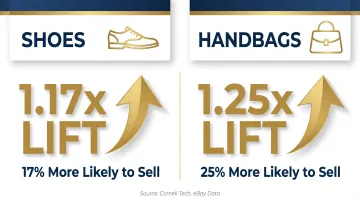
These lifts compound across large catalogs. For a brand with 5,000 SKUs in handbags alone, a 25% conversion improvement translates directly into the revenue column — not from more traffic, just from better images.
Platforms Algorithmically Reward Quality Images
Amazon's image requirements mandate a minimum of 1,000 pixels on the longest side (2,000 pixels recommended for zoom functionality) and require products to fill at least 85% of the frame against a pure white background. These aren't arbitrary standards — platforms algorithmically factor image quality into search rankings.
Poor image quality doesn't just reduce conversion on the page; it reduces the traffic that reaches the page in the first place.
Model Shots Outperform Flat-Lay and Packshots
Amazon requires on-model photography for men's and women's clothing listings — and the conversion data supports why. Garments photographed on models consistently outperform flat-lay and packshot alternatives because they answer the questions shoppers actually have:
- How does this fit on a real body?
- What's the proportion relative to height and build?
- How does it look styled — tucked, layered, or worn casually?
Flat-lays and packshots can't answer those questions. Model imagery closes that gap, which is why it converts at a higher rate across virtually every apparel category.
Poor Image Quality and the Fashion Returns Problem
The Financial Scale of E-Commerce Returns
NRF and Happy Returns' 2024 research reveals the staggering cost of returns: total returns for the retail industry reached $890 billion in 2024, with e-commerce averaging a 16.9% return rate.
Fashion return rates are even higher. Online apparel orders have a 25% chance of being returned — and 38% of those returns are due to fit issues that better imagery could help address.
Image Mismatch Drives Returns
Salsify data shows that 45% of shoppers have returned items in the past due to inaccurate or low-quality product content. In fashion, where color rendering, fabric texture, and fit are difficult to convey, the gap between "image expectation" and "product reality" is widest.
Better Images Enable Better Fit Assessment
Research by Chrimes et al. demonstrates that in fashion e-commerce, the number and type of product images — along with zoom functionality — significantly affect how accurately consumers can judge clothing fit before purchase. That connection between visual quality and fit confidence directly determines whether a purchase gets kept or returned.
Many Sites Still Have Fixable Image Gaps
Baymard Institute benchmarks reveal that a surprising share of fashion sites still fall short on the basics:
- 25% of e-commerce sites provide insufficient image resolution or zoom
- 14% have low-resolution images that negatively affect brand perception
- 28% don't provide "in-scale" images showing product size relative to a known reference
Each of these gaps has a direct fix — higher-resolution assets, zoom enablement, and lifestyle or on-model images that give shoppers a realistic sense of scale and drape.
Fashion-Specific Image Elements That Drive Purchase Decisions
The Essential Visual Components
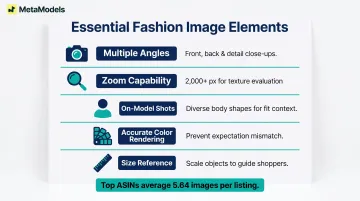
Research identifies the key visual components that matter most in fashion product photography:
Multiple angles — front, back, and detail close-ups — enable thorough product evaluation. Vizit's analysis shows the #1-ranked ASINs for the top 500 Amazon search terms average 5.64 images per listing.
Zoom capability is critical for fabric texture evaluation — Amazon recommends 2,000+ pixels on the longest side to enable it effectively.
Model shots for fit context: Showing garments on diverse body shapes significantly helps shoppers judge fit. Chrimes et al. found that visual fit information outweighs verbal descriptions at the final purchase decision.
Accurate color rendering across device screens is essential — expectation mismatches from color drift are a leading driver of returns.
Size-reference imagery: Dang and Nichols found that shoppers pay measurably more attention to photos when objects that help gauge product scale are included.
Background and Composition Best Practices
Research consistently shows that clean, distraction-free backgrounds outperform busy lifestyle settings for driving purchase intent. The product must be the unambiguous focal point, not the environment. Wang et al.'s framework confirms that complex backgrounds can distract from the product, reducing consumer interest. This matters even more when you consider where most shoppers are browsing.
The Mobile-First Reality
78.8% of all fashion e-commerce site traffic comes from mobile devices. Small screens amplify every flaw — a cluttered background or soft focus that's forgivable on desktop becomes a conversion killer on a 6-inch display. Brands that don't optimize image quality for mobile are effectively handing those sales to competitors who do.
Scaling High-Quality Fashion Imagery Without Breaking the Budget
The Core Tension for Fashion Brands
The image quality standards required to convert shoppers are well-established. But traditional model photography is expensive per final retouched image, slow, and difficult to scale — particularly for brands launching multiple collections, SKUs, or size variants per season.
AI-Powered Fashion Imagery as the Solution
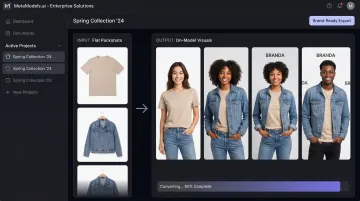
Platforms like MetaModels.ai address this by converting packshots into on-model imagery using a curated library of diverse AI models (varied ethnicity, body types, demographics). Brands can produce human-reviewed, brand-consistent visuals at up to 4K resolution — no model fees, studio costs, or royalties required.
Key capabilities include:
- Real-time fabric draping technology that preserves garment color, shape, texture, and proportions
- Human review by fashion specialists for every image before delivery
- Customizable AI models matching brand identity and customer demographics
- Ready-to-post formats for major e-commerce platforms including Myntra, Ajio, Flipkart, and Amazon
- Affordable per-image pricing, compared to traditional photography costs that run far higher per shot
The Business Case for AI Imagery
Better images lift conversion rates and reduce returns — the ROI on AI-generated imagery follows directly. Lost sales from low-quality visuals and elevated return rates cost brands far more than the per-image price of a scalable alternative.
The AI-generated fashion photography market grew from approximately $1.51 billion in 2024 to $2.01 billion, reflecting rapid adoption by fashion brands seeking to maintain quality while scaling production.
Frequently Asked Questions
How many product images does a fashion e-commerce listing need?
Most platforms recommend 5-8 images per listing, covering front, back, detail, model shot, and scale reference. Top-performing ASINs on Amazon average 7+ images — noticeably more than the minimum.
Does showing clothing on a model really increase conversions compared to flat-lay images?
Yes. Model shots consistently outperform flat-lay images in fashion because they communicate fit, drape, and proportion — details a garment lying flat simply cannot convey. Amazon mandates on-model photography for men's and women's clothing precisely for this reason.
What image resolution is recommended for fashion e-commerce product pages?
Amazon's minimum is 1,000 pixels on the longest side to activate zoom functionality. The recommended standard is 2,000+ pixels, which enables optimal zoom experience and is critical for fabric and texture evaluation in fashion.
How does poor image quality contribute to fashion return rates?
When images fail to accurately represent colour, fit, or texture, customers receive something that doesn't match what they ordered — the leading driver of fashion returns. Getting images right is one of the most direct ways to reduce return costs.
Can AI-generated fashion images perform as well as traditional photography for e-commerce?
Yes — when AI-generated images are human-reviewed for garment accuracy, they meet the resolution, consistency, and quality standards e-commerce conversion requires. The practical advantage is eliminating photoshoot costs and turnaround time without sacrificing output quality.
How does image quality affect a fashion listing's search ranking on marketplaces like Amazon?
Major platforms factor image quality directly into search ranking. Listings that don't meet resolution or background standards risk algorithmic suppression — cutting both organic traffic and on-page conversion at the same time.