Introduction
Influencer-driven fashion brands are caught between two hard realities. Creator costs keep climbing — 35.4% of marketers cite them as their top challenge in 2026 — while content quality varies wildly between collaborators.
A typical mid-tier influencer charges $2,000-$10,000 per post. Maintaining a weekly posting schedule across Instagram, TikTok, and Pinterest demands 15-20 unique assets monthly. At that volume, traditional shoots become logistically and financially unsustainable.
AI fashion model content changes that equation directly. Brands using AI-generated fashion imagery are producing on-model visuals at $1-$5 per image versus $80-$150 for traditional photography, compressing production timelines from weeks to hours — without booking talent or scheduling a single shoot.
This guide covers the business case for AI model content in influencer strategies, which content formats perform best, how to create and scale platform-native assets without traditional shoots, and the ethical guardrails brands must follow to maintain audience trust.
Key Takeaways
- AI fashion model content produces influencer-quality visuals without real models, shoots, or scheduling constraints
- Works across all influencer formats — lifestyle shots, UGC-style posts, lookbooks, product showcases, and platform-specific content
- Strategic implementation matters: clear brand briefs, diverse model representation, and platform-native creative direction drive better results
- Transparent disclosure builds trust: audiences and platforms expect clarity about AI-generated imagery
- MetaModels.ai converts packshots into 4K model content with human review, removing model booking, shoots, and post-production costs
Why AI Fashion Model Content Is Redefining Influencer Strategy
Traditional influencer partnerships drain budgets through high per-post fees, unpredictable content quality, and rights and exclusivity negotiations. More importantly, they can't maintain the consistent brand visual language required across multiple creators and platforms.
According to the Influencer Marketing Hub Benchmark Report 2026, influencer costs break down as follows:
- Nano influencers (1K-10K followers): Under $500 per post (55% of respondents)
- Micro influencers (10K-50K): Under $500 (45.5%) to $500-$2,000
- Mid-tier (50K-500K): $2,000-$10,000 per post
- Macro/mega (500K+): Over $10,000, with celebrity activations reaching $7-10 million
The AI fashion model market reached $703.5 million in 2025 and is projected to hit $6.2 billion by 2036 at a 21.7% CAGR. Those numbers tell a clear story: brands are building owned content pipelines using AI models to produce lifestyle, editorial, and UGC-style visuals at a fraction of traditional costs.
Why AI model content works specifically for influencer strategies:
- Cost efficiency at scale: Traditional fashion photography costs $80-$150 per image plus retouching; AI-generated content costs $1-$5 per image all-inclusive
- Diverse representation by design: Select different body types, ethnicities, and age groups without booking constraints
- No scheduling or rights complications: Generate content on-demand without talent availability, licensing fees, or exclusivity negotiations
- Platform-native format flexibility: Produce Instagram feed posts, Stories, TikTok thumbnails, and Pinterest boards from the same asset without reshooting
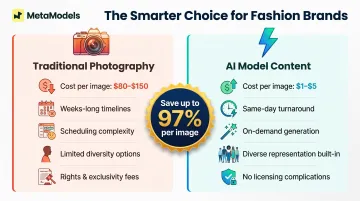
The strongest influencer strategies use both. AI model content handles always-on social feeds, product launches, and seasonal campaigns. Human creator partnerships stay reserved for high-trust moments — testimonials, community engagement, and launches that require genuine audience connection.
The Content Formats That Perform: AI Model Content for Influencer Campaigns
Lifestyle and UGC-Style Posts
The highest-performing influencer content looks native to its platform—lo-fi lighting, real-world settings, candid poses. AI model content can be art-directed to replicate this aesthetic through:
- City streets and urban environments
- Apartment interiors with natural lighting
- Golden-hour outdoor settings
- Coffee shop and retail locations
Research shows that 64% of consumers are more likely to buy when they see products in lifestyle settings. This applies whether the setting is captured traditionally or generated with AI.
Product Showcase and E-Commerce Imagery
On-model product photos increase e-commerce conversion rates by 20-33% versus packshots alone. AI models wearing actual garments—converted through fabric draping technology—produce the same conversion benefit as traditional influencer posts showing how garments fit and move.
76% of shoppers say model photos are the most useful format for purchase decisions, making on-model imagery essential for product pages and social commerce.
Lookbooks and Editorial Campaigns
Seasonal lookbooks traditionally require full production crews, location scouting, and multi-day shoots. AI-generated editorial content applies consistent aesthetic treatment across entire collections, making seasonal campaigns viable for brands at every scale.
Mango proved the concept, launching the first fully AI-generated fashion campaign for its Teen line across 95 markets in July 2024, with human art direction and retouching maintaining brand quality.
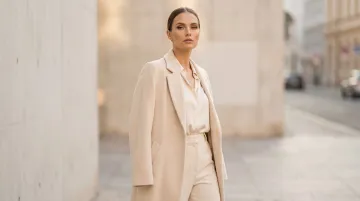
Platform-Specific Creative
Content needs vary dramatically by platform:
- Instagram feed: 1:1 or 4:5 aspect ratio, polished aesthetic
- Instagram Stories: 9:16 vertical, casual and interactive
- TikTok: 9:16 vertical video thumbnails optimized for scroll-stopping
- Pinterest: Multiple aspect ratios, high-resolution lifestyle imagery
AI model content adapts to each format's visual language and technical specifications without reshooting. According to Rival IQ's 2025 Social Media Benchmark Report, carousels outperformed Reels on Instagram for fashion brands in 2025, proving that multi-image posts still drive engagement—and AI enables producing carousel sets at volume. and AI enables producing carousel sets at volume. For influencer campaigns specifically, that flexibility means one creative brief can span every channel without a single reshoot.
How to Create Influencer-Quality AI Model Content: A Practical Framework
Brief First, Generate Second
AI model output quality depends entirely on creative brief clarity. Define these elements before generation:
Essential brief components:
- Target audience persona and demographics
- Platform context and content format
- Mood, aesthetic, and visual references
- Garment details and styling requirements
- Setting and environmental context
Luxury brands approach AI briefing by specifying what the model "believes, feels, and stands for"—not just physical attributes. This depth produces consistent, brand-specific results rather than generic outputs.
Choose Models That Reflect Your Audience
Model diversity drives both inclusion and conversion. Research indicates that diverse model representation can increase conversion rates by approximately 29%, while over 50% of UK consumers factor brand diversity efforts into purchase decisions.
MetaModels.ai's curated model library spans diverse ethnicities, body types, and age groups — letting brands build influencer content that reflects their actual audience, not a single default archetype.
Key diversity dimensions:
- Ethnicity and skin tone
- Body type and size range
- Age and generational representation
- Styling preferences and cultural context
Maintain Garment and Brand Accuracy
Standard AI fashion tools frequently get garments wrong: colors shift, prints distort, construction looks physically impossible. Fixing these errors after generation costs time and credibility.
MetaModels.ai addresses this by draping actual garment fabric onto AI models, preserving color, shape, texture, print, and proportions. Every image then goes through human review by fashion specialists before delivery — so garments display correctly and brand credibility stays intact.
Common garment accuracy failures in generic AI tools:
- Color and tone drift from the original product
- Distorted or tiled prints that don't match the source
- Structural details (seams, closures, volume) rendered incorrectly
Build a Repeatable Content Workflow
Once your brief and model selection are locked, the production process runs end-to-end without scheduling delays or location constraints:
- Upload a packshot or garment image as the source asset
- Select an AI model from the curated library that fits your audience
- Apply your creative brief — styling, setting, mood direction
- AI generates the initial content based on your inputs
- Fashion specialists review each image for garment accuracy
- Adapt outputs to platform specs (grid, story, banner, lookbook)
- Queue content for publication across channels
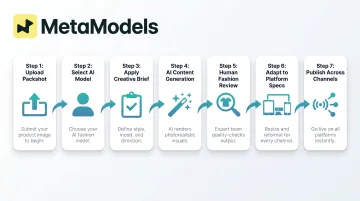
The result: consistent, influencer-aesthetic content at volumes a traditional shoot can't replicate — and without the lead time.
Scaling Influencer Content Across Platforms Without Extra Shoots
Social media algorithms reward consistent, high-frequency posting. Benchmarks show top-performing fashion brands post approximately 5 times per week on Instagram and TikTok. Traditional shoot cycles can't sustain this volume.
Solving the Volume Problem
AI model content enables producing daily or weekly variations from the same garment or collection without additional production cost. For a 300-SKU catalog across three seasons, traditional photography costs approximately $186,000 annually versus $11,600 with AI—a savings of $174,000.
Fashion listings require 8-12 images per product for optimal conversion. Multi-angle sets deliver a 65% conversion rate lift. AI makes this volume operationally viable.
Multi-Market Adaptation
The same AI model content can be adjusted to reflect:
- Different regional aesthetics and cultural contexts
- Seasonal variations (summer vs. winter styling)
- Local holidays and cultural moments
- Regional size and fit preferences
Mango's AI campaign deployment across 95 markets from a single asset set shows how brands can serve global audiences without separate regional shoots. Mango's AI campaign across 95 markets from a single asset set shows how brands can serve global audiences without separate regional shoots. That kind of reach is now accessible at any scale.
Brand Consistency Advantage
Managing multiple human creators often produces visual inconsistency—different lighting, composition, editing styles. AI model content maintains a locked visual signature across all platform outputs:
- Consistent lighting and color grading
- Unified composition and framing
- Cohesive tone and aesthetic treatment
- Predictable brand visual language

The result: every piece of content — regardless of platform or campaign — looks like it came from the same shoot.
Ethics, Authenticity, and Disclosure in AI Influencer Content
Transparency Requirements
Most major social platforms now require or strongly encourage disclosure when content features AI-generated figures. Compliant disclosure protects brand credibility and meets regulatory expectations.
Platform-specific disclosure:
- Meta (Instagram/Facebook): Auto-applies "AI Info" labels when detecting C2PA/IPTC metadata; creators can manually disclose
- TikTok: Requires disclosure toggle before posting realistic AI-generated content
- YouTube: Mandates disclosure of "altered or synthetic content" that appears realistic
- Pinterest: Discloses AI use in ad transparency tools
The EU AI Act Article 50 mandates machine-readable marking of synthetic content. Proactive transparency builds trust rather than eroding it.
Consumer Attitudes
Stylitics research reveals that 59% of shoppers want clear labeling of AI-generated imagery, and 50% would trust a brand less if AI use is undisclosed. Brands that lead with disclosure consistently outperform those that stay silent on it.
Key findings:
- Most shoppers (71%) cannot tell AI from real photos on first view — meaning the visual quality bar is already high enough to pass
- 75% express concern about AI use in product imagery
- 55% are comfortable buying from AI images if clear return policies exist
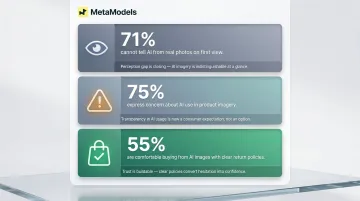
Those concern numbers also point to an opportunity: brands that disclose AI use and back it up with strong return policies capture the majority of skeptical shoppers. The highest-converting approach is "hybrid AI" — keeping the actual product as a real photograph while using AI to generate the background, styling environment, or model presentation.
Representation Responsibility
The consumer trust data above has a direct implication for model selection: audiences engage more with content featuring people who look like them. AI model libraries reflect brand choices, making diversity a strategic decision as much as a values one.
Avoid these risks:
- Reinforcing narrow beauty standards by defaulting to a single model type
- Using AI to perform diversity without genuine commitment — Levi's faced significant public backlash for exactly this
- Using AI to avoid hiring diverse human models for hero content
The Authenticity Debate
AI model content is not deceptive when disclosed and used for commercial product imagery. The real ethical risk is implied human endorsement — suggesting a real person recommends a product when none exists. Clearly labeled AI product photography doesn't carry that risk. The practical standard: disclose the generation method, show the actual product accurately, and let customers decide.
Frequently Asked Questions
Can AI-generated fashion model content replace real influencer partnerships?
AI model content works best as augmentation, not full replacement. Use it for always-on content volume and product imagery while reserving human influencers for authentic audience trust and storytelling during key brand moments like launches and community campaigns.
How should brands disclose AI-generated model content on social media?
Add clear labels in captions — "Created with AI" or "AI-generated imagery" — and use platform-specific disclosure tags where available (Meta's "AI Info" label, TikTok's disclosure toggle). Transparency protects brand credibility and keeps you ahead of emerging regulatory requirements.
What fashion content types work best with AI models for influencer campaigns?
The strongest performers are lifestyle/UGC-style posts, product showcases, seasonal lookbooks, and platform-adapted editorial content. On-model photos increase conversion by 20-33% over packshots — making AI model content a particularly strong fit for e-commerce and social commerce.
How do I ensure AI-generated garment imagery looks accurate and on-brand?
Choose platforms that combine fabric draping technology with human review to catch garment detail issues before delivery. Pair that with clear visual briefs covering garment construction, color accuracy, and brand aesthetic requirements for consistent results.
How diverse can AI fashion models be in influencer-style content?
Dedicated platforms offer curated libraries spanning wide ranges of ethnicities, body types, ages, and styling aesthetics. Building diverse representation into your content strategy is a smart decision on both ethical and commercial grounds — research points to roughly 29% conversion increases from inclusive imagery.
How long does it take to produce influencer-style content with AI models compared to traditional shoots?
AI model content reduces production timelines from 4-8 weeks to same-day turnaround. Platforms deliver ready-to-post assets at up to 4K resolution without booking, travel, or post-production delays, enabling brands to maintain high-frequency posting schedules traditional shoots cannot sustain.