AI fashion models are increasingly discussed, but their real value is practical and measurable: fewer delays, lower per-SKU costs, and catalogs ready to publish in hours instead of weeks. Production delays cost the fashion industry over $1 trillion in lost revenue annually, with out-of-stock items alone accounting for up to $634.1 billion in lost sales (Inspectorio, 2022, https://inspectorio.com/blog/the-cost-of-production-delays-for-apparel-and-fashion-retailers).
This article examines the specific advantages AI fashion models deliver for catalog creation, who benefits most, and what brands actually lose by skipping them.
Key Takeaways
- AI fashion models convert garment photos into on-model catalog imagery — no photoshoots, no model bookings, no studio time required
- Dramatically faster production timelines, lower cost per SKU at scale, and diverse demographic representation without the scheduling overhead of traditional shoots
- Brands using traditional shoots face scheduling delays, rising per-image costs, and limited flexibility to test or iterate visuals
- Catalogs that switch to AI model imagery typically cut production time from weeks to days, with no drop in visual quality
What Are AI Fashion Models for Catalog Creation?
AI fashion models are software tools that take a garment photo—flatlay, packshot, or ghost mannequin image—and generate a photorealistic image of a model wearing that garment, with accurate fabric draping, realistic lighting, and correct garment details.
Where they're most commonly applied:
- Product detail pages on e-commerce sites
- Marketplace listings (Amazon, Zalando, ASOS)
- Lookbooks and seasonal campaign assets
- Social media content and paid advertising
- Marketing creative assets requiring on-model visuals at volume
AI fashion models function as production tools, not creative replacements. Their value lies in removing operational friction from the path between a finished garment and a publish-ready catalog image, not in replacing the brand vision behind those images. MetaModels.ai, for instance, converts packshots and flat-lay images into on-model fashion imagery and video — including human-reviewed outputs — so garment accuracy is maintained from input to publish-ready asset.
Key Advantages of AI Fashion Models for Faster Catalog Creation
The advantages below are operational, not theoretical. Each one directly affects metrics fashion brands and e-commerce teams track: launch timelines, cost per image, catalog coverage, and conversion quality. These advantages compound as catalog volume increases—a brand producing 50 SKUs per season sees a different scale of benefit than one producing 500.
Advantage 1: Compressed Production Timelines
AI fashion models eliminate every scheduling dependency in traditional catalog production. There are no model availability windows, no studio booking lead times, no multi-day edit queues. A garment image moves from packshot to on-model catalog asset within hours.
How this works in practice: A brand uploads a product image, selects a model from a curated library (or uses a custom brand model), and receives photorealistic on-model images without coordinating a single external resource.
Why this is an advantage:
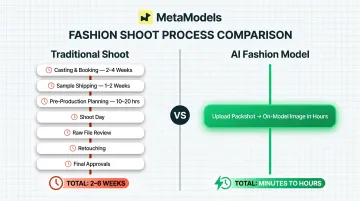
Traditional catalog photoshoots involve sequential handoffs—casting, scheduling, shoot day, raw file review, retouching, and final approvals—each adding days to a launch timeline. Professional studio shoots require 2-4 weeks end-to-end, with high-end editorial shoots requiring 3-6 weeks (JoinTellos, 2026, https://www.jointellos.com/blog/fashion-photography-cost-2026-traditional-vs-ai). Sample shipping alone takes 1-2 weeks, and pre-production planning requires 10-20 labor hours. Worse, 15-20% of shoots require partial reshoots costing $2,000-$10,000 each.
AI collapses this into a single automated step. Tools generate results in minutes—platforms like Genera's AI produce up to 2,000 final images daily (Forbes, 2026, https://www.forbes.com/sites/stephanrabimov/2026/04/26/genera-bets-ai-can-replace-the-fashion-photoshoot-industry/).
Le Coq Sportif's CEO Alexandre Fauvet put it plainly: "What used to require a 5,000 Euro photoshoot, complex logistics, and weeks of coordination can now be executed on demand." The brand reshaped its visual identity pipeline in under one month using Genera's AI, freeing two production staff for campaign strategy and brand content.
In fashion, speed is directly tied to competitive position. Being first to list a trending style on a marketplace or first to refresh creative for a seasonal campaign has measurable revenue impact. Fast fashion benchmark Shein lists new products in as little as 3 days from design to listing (McKinsey, 2025; Rawshot, 2026).
KPIs impacted:
- Time from garment sample to live product page
- Catalog launch lead time
- Number of SKUs published per sprint
- Creative iteration speed for paid ads
When this advantage matters most: High-frequency drop schedules, micro-collection launches, marketplace restocking scenarios, and seasonal campaigns where a delay in catalog visuals delays revenue.
Advantage 2: Lower Cost Per SKU at Scale
AI fashion models replace a recurring per-shoot cost structure with a scalable per-image model, removing model booking fees, agency commissions, studio rental, styling costs, and reshoot expenses from the catalog production budget.
The cost dynamic in practice:
As catalog volume grows, the cost per image with traditional shoots either stays flat or increases (more shoot days, more models, more editing hours). AI-generated images scale at a fraction of that cost.
Traditional photoshoot costs (per final retouched image):
- Startup/Indie tier: $60-$270 per image, 15-25 images per day
- Growing D2C tier: $125-$600 per image, 25-40 images per day
- Established/Editorial tier: $300-$1,500+ per image, 30-50 images per day
Daily traditional spend breakdown:
- Photographer: $1,000-$5,000+
- Agency models: $600-$1,500/day (standard); $1,500-$4,000/day (editorial)
- Studio rental: $300-$2,500
- Hair and makeup: $400-$2,400
- Wardrobe stylist: $400-$1,000
- Basic retouching: $25-$50/image; high-end retouching: $75-$150/image
- Total daily spend: $1,500-$25,000+ (Adstronaut, 2026, https://www.adstronaut.net/blog/how-much-does-a-fashion-photoshoot-cost)
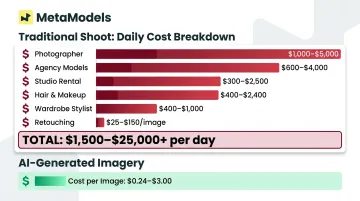
AI-generated imagery costs: AI cost per image ranges from $0.50-$3.00, with platforms like Genera averaging $0.50-$1.50 per image (Forbes, 2026; JoinTellos, 2026). MetaModels.ai operates on a no-models, no-royalties model with pricing starting from $0.24 per image, with no recurring licensing fees tied to image usage—a direct and ongoing cost advantage versus traditional model photography rights.
For brands with large SKU counts or frequent catalog refreshes, this directly improves unit economics and frees budget for other marketing activities.
KPIs impacted:
- Cost per catalog image
- Total catalog production budget
- Cost per SKU
- Ratio of production cost to average order value
- Reshoot frequency and associated spend
When this advantage matters most: Brands scaling SKU count season-over-season, fast-fashion and D2C brands with weekly or bi-weekly drops, businesses expanding into new markets who need catalog refreshes without repeat shoot investments.
Advantage 3: Scalable Diversity and Representation Without Logistical Overhead
AI fashion models allow brands to represent multiple body types, ethnicities, ages, and demographics across their catalogs without booking multiple models for every shoot—a logistical challenge that has historically made inclusive representation expensive and operationally complex.
AI platforms with curated model libraries or custom model creation tools let brands select or design models that reflect their target customer segments, apply them consistently across entire collections, and adjust representation by region or channel without repeat production costs.
Research published in the Journal of the Academy of Marketing Science by Zhang, Ikonen, Eelen, & Sotgiu (2024) identified the "Dissimilarity-Risk Deterrence Effect" (DRD): thin models dissuade consumers with larger clothing sizes from purchasing due to perceived body-size dissimilarity and heightened fit-risk perception (https://d-nb.info/1344197264/34). Own-size models increase purchase intent by raising perceived similarity and lowering fit risk—with the strongest effect on high-fit-risk items like dresses versus lower-risk items like shoes.
The same study found thin models are perceived as less authentic than own-sized models. In multi-product displays, consumers with larger sizes were significantly more likely to choose items shown on larger models, meaning model size actively channels consumers toward specific inventory.
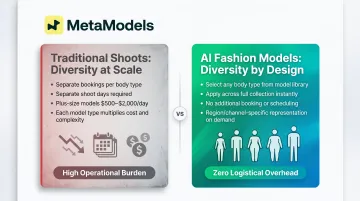
From an operational standpoint, traditional shoots require separate booking, scheduling, and often separate shoot days for different body types. Plus-size and specialty models cost $500-$2,000/day versus standard agency models at $600-$1,500/day (JoinTellos, 2026). Each additional model type multiplies production complexity and cost. AI removes this entirely, making representation a design decision rather than a logistics challenge.
Brands that match model representation to their actual customer demographics gain on both conversion and return rates—customers who see garments on their body type make more accurate purchase decisions and return fewer items.
KPIs impacted:
- Catalog coverage across demographic segments
- Conversion rate by model representation type
- Return rate (customers who see garments on their body type make more accurate purchase decisions)
- Brand sentiment metrics
When this advantage matters most: Brands entering new geographic markets with different demographic profiles, inclusive fashion labels, any brand with a broad size range that has historically struggled to show garments on diverse body types at scale.
What Happens When Brands Skip AI Fashion Models for Catalog Production
For brands still running traditional shoots for full catalog output, production becomes a recurring bottleneck. It limits how fast collections get listed, how frequently visuals are refreshed, and how many SKUs can realistically be photographed per season. Catalog gaps—products listed without on-model images—are a direct consequence.
Compounding cost and quality risks:
- Rising per-image costs as model and studio fees climb — the Global Modeling Agency Market is projected to grow at 5.2% CAGR through 2035, pushing traditional talent costs higher
- Inconsistent visual quality across a catalog when shoots are spread across multiple studios, photographers, or model casts
- Inability to react quickly to trend shifts or platform algorithm changes that reward fresh creative
- Difficulty scaling representation across body types or regions without proportionally scaling production spend
For brands in competitive marketplaces, catalog pages without on-model imagery—or with inconsistent imagery—lose conversion ground to competitors who can maintain visual consistency at volume.
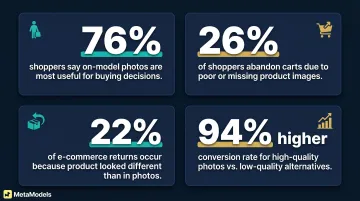
The shopper data makes the stakes concrete:
- 76% of shoppers say on-model photos are the most useful format for buying decisions (Stylitics/Aha Studio)
- 26% of shoppers abandon carts due to poor or missing product images (BlendNow, 2025)
- 22% of e-commerce returns happen because the product looked different in person than in photos
- High-quality photos correlate with a 94% higher conversion rate versus low-quality alternatives
What makes this shift viable right now: 71% of shoppers could not tell the difference between real and AI-generated apparel images, and 60% react neutrally or positively to AI-generated imagery. The quality bar for commercial use has already been met.
How to Get the Most Value from AI Fashion Models
AI fashion models deliver the greatest catalog impact when integrated into a repeatable production workflow. That means establishing a consistent input standard—clean background packshots at uniform angles—and building in two ongoing practices: structured quality review and performance-driven refinement.
Quality review matters even when AI handles the heavy lifting. MetaModels.ai, for example, routes every generated image through fashion specialists who check garment accuracy, fabric draping, and detail preservation before delivery. This keeps AI output on par with what traditional photography produces.
For the refinement side, treat your catalog as a living feedback system:
- Audit each batch of AI-generated images against brand guidelines
- Check for consistency across diverse model outputs
- Track conversion rates and return rates per style
- Use that data to refine model selection, poses, and background treatments over time
This feedback loop calibrates the AI workflow to stay brand-aligned as your catalog scales.
Conclusion
AI fashion models represent a fundamental shift in production infrastructure — giving fashion brands direct control over catalog timelines, cost structure, and visual representation at a scale traditional photoshoots cannot match.
The advantages compound over time. A brand that builds AI fashion model generation into its standard catalog workflow progressively widens the gap between its production speed and competitors still dependent on studio shoots.
With fast fashion brands like Shein adding between 2,000 and 10,000 new styles per day, according to a McKinsey, 2025 report, the ability to produce catalog-ready visuals at that pace has become a competitive necessity.
Frequently Asked Questions
How long does it take to create a fashion catalog using AI models?
AI-generated catalog images can typically be produced within hours of uploading a garment photo, compared to the 2-4 weeks required for traditional shoot scheduling, production, and editing. Some platforms generate results in minutes, with enterprise-grade systems producing up to 2,000 final images daily.
Can AI fashion models accurately represent garment details like fabric texture, prints, and seams?
Purpose-built AI fashion platforms use real-time fabric draping technology and human review to preserve garment accuracy. MetaModels.ai, for example, reviews every image for color, shape, and proportions before delivery—though results vary by platform and input image quality.
How much can AI fashion models reduce catalog production costs?
AI-generated images cost $0.50-$3.00 per image versus traditional photoshoot costs of $60-$1,500+ per final retouched image. Savings scale with catalog volume since there are no model booking, studio rental, or reshoot fees.
Do AI-generated catalog images meet marketplace and e-commerce platform requirements?
Leading AI fashion model platforms produce images in formats and resolutions suitable for major marketplaces including Amazon, Zalando, and ASOS. Platforms like MetaModels.ai generate marketplace-compliant images with white/neutral backgrounds and specific aspect ratios, though brands should verify requirements for their specific platforms.
Can brands maintain a consistent visual identity across a full catalog using AI fashion models?
Brands can maintain consistency by using reusable model templates or custom brand models, standardized backgrounds, and consistent input image quality across all garments. Platforms that offer custom model creation and end-to-end production management ensure brand identity is preserved at scale.
Are AI-generated fashion catalog images cleared for commercial use?
Review the terms of service for each platform you use. Most purpose-built platforms, including MetaModels.ai, grant full commercial rights with no model royalties — meaning you can use images across paid advertising, marketplace listings, and social media without licensing restrictions.