Introduction
A typical professional fashion shoot runs $2,000-$8,000 per session, with per-image costs hitting $50-$500 once you factor in models, studios, stylists, and post-production. For apparel merchandising teams publishing on-model images across every SKU, colorway, and seasonal drop, that math breaks down fast.
The pace of releases has only made it worse. Fashion brands have significantly increased their annual collection drops over the past two decades, and traditional photoshoots simply can't keep up.
AI-generated catalog images solve this by converting packshots or flat lays into on-model, retail-ready visuals, no model bookings or studio time required. This guide covers how the technology works, the merchandising benefits it delivers, and where it fits in your existing workflow.
Key Takeaways
- Convert packshots to on-model images without traditional photoshoots or model bookings
- Reduce per-image costs from $50–$500 to single-digit dollars while compressing timelines from weeks to days
- Platforms like MetaModels.ai deliver fabric-accurate, 4K-resolution images with human quality review built into every output
- Deploy brand-consistent visuals across PDPs, lookbooks, and paid campaigns without reshoots
- Extend inclusive representation across your full catalog, not just hero campaigns
Why Traditional Catalog Shoots Hold Apparel Brands Back
The Compounding Cost Structure
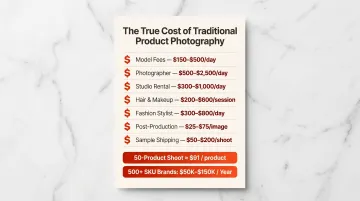
Traditional fashion photoshoots stack costs rapidly. A mid-range session typically includes:
- Model fees: $500–$2,000/day
- Photographer: $500–$3,000/day
- Studio rental: $200–$1,000/day (NYC/LA: $1,000–$3,000+)
- Hair and makeup: $200–$800/day
- Fashion stylist: $300–$800/day
- Post-production: $10–$50/image (extensive retouching: $50–$150)
- Sample shipping and logistics: $50–$500+
A 50-product shoot can run $4,550 total (roughly $91 per product). Premium campaign-level production jumps to $15,000–$25,000 per day. Growing brands shooting 200 products across 4–6 sessions annually face $25,000–$60,000 in photography budgets. Established brands with 500+ products spend $50,000–$150,000+ yearly.
15–20% of fashion photoshoots require reshoots, adding $500–$2,000+ per event. Image inconsistency alone drives 10–20% conversion rate reductions.
The Time-to-Market Bottleneck
By the time catalog images are shot, edited, and approved, trend windows have shifted. Fashion brands have nearly doubled their collection releases since the early 2000s. Fast fashion players like Zara introduced hundreds of new items weekly in the 1990s. Today, Shein operates 7 days faster than leading fast-fashion competitors in moving concepts to customers.
Weekly or bi-weekly drops have replaced seasonal calendars. While your shoot is still in post-production, competitors are already listing similar items — and capturing the demand that came with the trend.
The Scalability Wall
Most brands deprioritize complete catalog coverage. With hundreds or thousands of SKUs across multiple colorways per season, secondary colorways, size variants, and test SKUs often lack on-model imagery entirely.
57.2% of fashion brands use flat lay photography as a core product image style. 28% of the largest 60 e-commerce sites fail to provide any "in scale" images—including on-model shots—even for best-sellers. Yet 56% of users browse product images first upon landing on a product page, and 42% attempt to gauge size from images alone.
The Inclusive Representation Gap
Getting diverse body types, ethnicities, and demographics adequately represented requires multiple model bookings per product, multiplying costs further. Most brands compromise, reserving diversity for hero campaigns while leaving hundreds of SKUs with narrow representation.
Body diversity in UK advertising fell from 28% to 15% between 2024 and 2025. Globally, it dropped from 15% to 12%. Yet creators representing non-typical body types sell proportionally more clothes than thin influencers with larger followings.
The Reshoot Problem
Every product update, colorway addition, or campaign refresh means re-entering the full shoot cycle. That translates to:
- Re-shipping samples to the studio
- Re-booking models and stylists around availability
- Re-renting space and coordinating production
- Waiting days or weeks before updated images go live
Each iteration burns budget and delays the catalog — with no shortcut when speed matters most.
How AI-Generated Catalog Images Actually Work
Core Input-Output Workflow
A brand uploads a product packshot or flat-lay image. The AI platform places the garment onto a selected AI model, simulates how the fabric drapes on that body, and outputs a retail-ready on-model image—no studio booking required.
Real-Time Fabric Draping Technology
Sophisticated platforms don't paste garments onto model images. They simulate how specific fabric weight, texture, and cut behave on a human body—creasing, drape, and fit included.
Purpose-built fashion imagery platforms like MetaModels.ai use real-time fabric draping alongside human-reviewed outputs to ensure garment accuracy. The technology has shifted from physics-based simulation to generative neural networks and diffusion models, delivering photorealistic rendering that preserves garment color, print, and proportions.
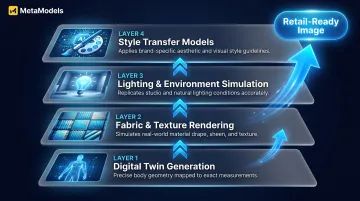
Production-grade systems layer several technologies to achieve this:
- Digital twin generation for accurate body geometry
- Fabric and texture rendering that responds to light and movement
- Lighting and environment simulation for scene realism
- Style transfer models that maintain brand-consistent aesthetics
Model Selection Layer
Brands choose from curated libraries of AI models across different ethnicities, body types, and demographics. Or they create custom AI models matching specific brand identity and target customer profiles.
Each model can be tailored for ethnicity, body type, age range, and styling—giving brands genuine representation across every catalog, not a one-size-fits-all default.
Quality Assurance Through Human Review
Model selection determines who wears the garment. Human review determines whether it looks right on them. Every image goes through verification by fashion specialists who check garment alignment, drape fidelity, and color accuracy before delivery.
Without this step, common AI artifacts slip through: incorrect button colors, missing wrinkles, inaccurate fabric textures, overly airbrushed faces. 71% of shoppers cannot distinguish between real and AI-generated product images when quality is high, but confidence drops when specific details are wrong.
Output Specifications
Production-ready AI catalog images are delivered in resolutions up to 4K, formatted for direct use across:
- E-commerce PDPs
- Social media (Instagram, Facebook, Pinterest, TikTok)
- Lookbooks and seasonal campaign PDFs
- Paid advertising (display campaigns, social ads)
- Marketplace listings (Amazon, Myntra, Flipkart)
Content arrives ready-to-post with marketplace-compliant backgrounds, optimized aspect ratios, and brand-consistent styling.
The Merchandising Impact: Benefits That Go Beyond Cost Savings
Cost Reduction at Scale
Eliminating model booking, studio rental, and repeated reshoots translates into substantial per-image savings. Zalando's AI transformation cut campaign production costs by 90%, reducing per-image costs from $150-$500 to single-digit dollars. A local Italian shop using AI on-model imagery reduced per-image costs from €14 to €1—a 93% savings.
Production crews shrink from 10-15 people to 2-3 specialists. Brands avoid administrative overhead managing model releases, usage restrictions, and geographic licensing clauses.
Speed to Market
AI catalog generation compresses content production from weeks to hours or days. Zalando reduced standard production cycles from 6-8 weeks to 3-4 days. Trend-responsive content becomes achievable in under 24 hours.
Integrated digital merchandising solutions deliver 50% improvement in speed to market and 8% rise in full-price sell-through. Faster listing correlates directly with higher sell-through rates. Trend-aligned content converts 3.2x better than generic photography.
Full Catalog Coverage at Scale
AI removes the coverage gap. Every SKU, every colorway, every size variant can have on-model imagery — not just hero products.
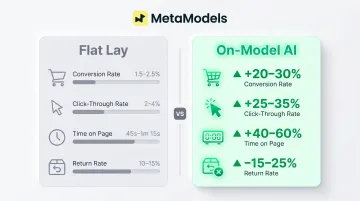
On-model imagery consistently outperforms flat-lay across every key metric:
- Converts 20-30% higher than flat-lay across most clothing categories
- Drives 25-35% better click-through rates from search thumbnails
- Increases time on page by 40-60%
- Reduces return rates by 15-25% when used as the primary product photo
67% of online shoppers say "not knowing how it will fit" is their top concern when buying clothing. Full catalog on-model coverage closes that gap directly.
Inclusive Representation as a Conversion Driver
Diverse AI model libraries — spanning body types, ethnicities, and demographics — are a measurable merchandising lever, not a checkbox. Customers who see themselves represented in product imagery convert at higher rates and return products less often.
Ads featuring positive, inclusive portrayals see up to 5% uplift in short-term effectiveness and 16% growth in long-term sales. In 2025, 65% of consumers said they valued brands that represent diversity and inclusion — up from 59% in 2021.
Creators representing non-typical body types (petite, oversized, bigger-busted, gender-neutral) sell proportionally more clothes than average thin influencers with larger followings.
Brand Consistency Across Channels
When all catalog images are produced through a single AI platform, visual consistency across backgrounds, lighting, poses, and styling is enforced automatically. This eliminates the significant challenge of maintaining consistency across multi-shoot catalogs with different photographers, studios, and production teams.
Brand-specific custom models ensure visuals always align with brand identity, whether publishing to PDPs, social media, paid ads, or lookbooks.
What to Look for in an AI Catalog Image Platform
Fabric and Fit Accuracy
This is non-negotiable. The platform must render drape, texture, color, and garment fit realistically, or images will fail to build shopper trust and increase returns.
Look for platforms with human review layers and quality controls. Research shows that AI-generated images significantly reduce purchase intent and recommendations in high-involvement decisions—exactly what fashion purchases represent.
Purpose-built fashion platforms address this directly. They simulate fabric behavior accurately and run outputs through human fashion specialists who verify color, shape, proportions, and garment details before delivery.
Model Diversity and Customization
Diverse model libraries aren't a nice-to-have—they're a conversion driver. Confirm the platform covers demographic diversity, body type diversity, and whether custom model creation is available to match your brand identity.
Platforms should support customization across ethnicity, body type, age range, and styling. Brand-specific model creation locks in visual consistency and ensures representation that matches your actual customer base.
Integration and Workflow Fit
How do AI-generated images connect to your existing systems—DAM, PIM, e-commerce platform, marketing channels? The best platforms remove post-processing from your team's plate entirely.
Look for:
- API access for enterprise-scale operations
- Marketplace-compliant output formats optimized per channel
- Content ready for PDPs, social ads, paid campaigns, and print lookbooks
- No additional editing required before publishing
Where AI Catalog Images Fit in Your Merchandising Workflow
PDPs and E-Commerce Listings
On-model AI images serve as primary conversion assets on product detail pages, replacing or supplementing flat lays to show fit and drape. Secondary images—detail views, alternate angles—can also be AI-generated for fully AI-produced listings.
Marketplace-compliant images with white/neutral backgrounds and optimized aspect ratios drive higher click-through and conversion rates on platforms like Amazon, Myntra, and Flipkart.
Lookbooks and Seasonal Campaign Content
AI-generated catalog images can be styled and composed for editorial-style lookbooks or seasonal campaign PDFs. Brands produce full collection lookbooks without campaign shoots, maintaining professional quality and brand consistency at a fraction of traditional costs.
Custom scenes and backgrounds matching brand vision enable diverse product presentations within a single merchandising workflow.
Social Media and Paid Advertising
AI catalog images produced at 4K resolution with brand-consistent styling are directly usable in social posts, Instagram ads, and display campaigns. Performance marketing teams get from product to live ad faster, without waiting on creative production cycles.
This opens up several practical capabilities for social and paid channels:
- Generate multiple product variations with different AI models, styling, and backgrounds for A/B testing across demographic representations
- Produce video content featuring AI models in motion, ready-to-post for reels and ad campaigns
- Skip video shoots, model bookings, and post-production editing entirely
Frequently Asked Questions
Can AI make a product catalogue?
Yes. AI generates complete product catalogues by converting packshots or flat lays into on-model, retail-ready images at scale. This covers every SKU and colorway without traditional photoshoots, so brands can publish comprehensive catalogs without scheduling a single shoot.
How accurate are AI-generated catalog images at showing fabric and fit?
Purpose-built fashion AI platforms simulate fabric weight, texture, and drape to produce garment-accurate images. Fashion specialists then verify color, shape, and proportions before delivery — unlike generic AI tools that often miss realistic fit and fall.
Do AI catalog images replace traditional photoshoots entirely?
Many brands use AI for the majority of their catalog coverage while reserving traditional shoots for hero campaigns or flagship products. AI excels at scale, consistency, and speed rather than replacing every creative use case. The hybrid approach balances efficiency with creative flexibility.
How long does it take to generate AI catalog images for an apparel brand?
AI-generated catalog images are typically delivered within hours to a day, compared to weeks for traditional photoshoot cycles. That turnaround means trend-responsive content can go live before competitors react.
Are AI model images legal and royalty-free to use commercially?
Reputable AI fashion imagery platforms provide commercially licensed outputs with no ongoing model royalties or usage restrictions. This removes the administrative overhead of model releases, exclusivity clauses, and geographic licensing entirely.
Can AI catalog images be used across e-commerce, social media, and lookbooks?
Yes. AI catalog images are delivered at up to 4K resolution, formatted to marketplace-compliant specifications for PDPs, social media, paid ads, and print-ready lookbooks — with no additional editing required.