Introduction
A single activewear season can mean 60+ SKUs — sports bras in eight colorways, compression leggings across five size runs, moisture-wicking tees with mesh panels. Every variant needs on-model photography that shows fit, fabric, and performance before the catalog goes live.
That volume makes traditional photoshoots impractical for most brands.
Multi-day studio shoots run thousands of dollars, return limited model diversity, and take weeks to retouch. Many brands end up launching with incomplete imagery — a direct hit to conversion rates on high-intent product pages.
This post covers how AI tools are now purpose-built to handle activewear catalog photography — from capturing compression textures and mesh panels to generating models across body types and use cases, all without booking a photographer or studio.
Key Takeaways
- Traditional activewear photoshoots cost £5,000-£10,000 per session and require 2-4 weeks to deliver final images
- AI tools convert packshots into on-model activewear photos in minutes, generating catalog-ready content at £0.50-£1.50 per image
- Modern AI platforms handle activewear-specific challenges: stretch fabric draping, diverse body-type representation, and dynamic action poses
- Brands using AI for catalog creation report 95%+ cost savings and turnaround times cut from weeks to hours
The Real Cost of Traditional Activewear Photography
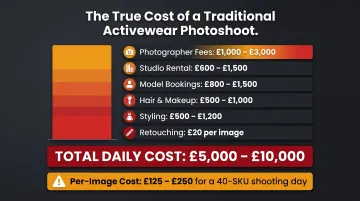
Traditional activewear catalog production is a costly, multi-layered operation. A mid-tier fashion photoshoot in a major city costs £5,000-£10,000 daily — and that figure stacks fast across:
- Photographer fees: £1,000-£3,000
- Studio rental: £600-£1,500
- Agency model bookings: £800-£1,500 per model
- Hair and makeup artists: £500-£1,000
- Styling: £500-£1,200
- Retouching: £20 per final image
For a typical 40-SKU shoot day, the all-in cost per product image ranges from £125-£250. Usage rights push that further: social media paid ad rights add 30-50% to model rates, and full buyouts run £5,000-£15,000+ per shoot.
The Colorway Multiplication Problem
Activewear amplifies costs sharply because of volume. A single legging style often launches in 6-10 colorways across multiple size runs, and performance collections can include 50-100+ SKUs per season. Each colorway variation ideally needs on-model photography to show colour accuracy and fabric behaviour.
Multiply 60 colorway variations × £125 minimum per product = £7,500 just for one style photographed across its full range. Brands shooting multiple styles face budgets that quickly exceed £20,000-£30,000 per seasonal catalog.
Timeline Bottlenecks That Delay Launches
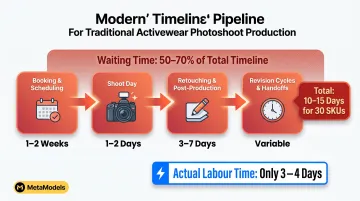
Cost isn't the only constraint. Traditional product photography workflows take 7-15 business days in-house or 2-4 weeks with freelance teams, with retouching as the most common bottleneck. Here's the timeline breakdown:
- 1-2 weeks: Booking photographer and models, coordinating schedules
- 1-2 days: Actual shoot day
- 3-7 days: Retouching and post-production
- 50-70% of total time is spent waiting, not working: retouching queues, team handoff delays, and revision cycles
For a batch of 30 SKUs, actual labour requires only 3-4 days, yet the calendar elapsed time stretches to 10-15 days. When launches are tied to seasonal windows or marketing campaigns, these delays directly cost sales.
The Representation Gap
Cost and time aren't the only constraints traditional shoots impose. Booking one or two models limits the body types, skin tones, and demographics shown in your catalog — and that directly impacts shopper confidence and conversion.
Research across 11 studies with 5,950 participants demonstrates that own-size model photography enhances online purchase decisions by reducing perceived fit risk. When shoppers see models dissimilar to their body size, fit risk increases and purchase intention drops significantly. The effect is strongest for fit-critical garments like leggings, sports bras, and compression wear.
The financial stakes are significant. Poor fit causes 53% of apparel returns, totalling £38 billion in returned online apparel annually. For fit-critical categories, size-inclusive imagery is a direct lever on return rates.
The infrastructure for achieving this, however, remains narrow:
- 95-97% of runway casting is straight-size
- Covering XS through XL requires multiple model bookings at £800-£1,500 each
- Separate fitting sessions and extended shoot days compound the cost
- The £5,000-£10,000 daily rate multiplies by 4-5× to represent diverse body types
What AI Does Differently for Activewear Catalog Photography
Packshot-to-Model Workflow
AI tools take a flat product photo — a packshot, flat-lay, or ghost mannequin image — and generate a photorealistic on-model image with accurate garment fit. Studio time, model bookings, and retouching queues are removed from the equation entirely.
The technical process combines computer vision to analyse garment structure, 3D modelling to create spatial fabric representations, and generative AI to produce the final photorealistic image combining model, garment, and environment.
Handling Activewear-Specific Fabric Challenges
Performance fabrics present unique challenges: compression panels need to show tension and fit, mesh inserts require transparency and texture, moisture-wicking materials have distinct sheen and drape behaviour.
Advanced AI platforms use real-time fabric draping technology that simulates how stretch and technical materials behave on the body. MetaModels.ai's real-time fabric draping specifically preserves garment details including colour, shape, texture, print, and proportions — accurately rendering stretch fabrics, moisture-wicking textures, compression fits, and athletic silhouettes.
Generic AI image tools struggle with garment fidelity. An independent Fstoppers review tested consumer-grade AI tools and found them "unusable" for professional e-commerce, citing failures in fabric texture, outfit consistency across angles, and resolution insufficient to show stitching and weave detail.
Fashion-specific AI platforms solve this by training models exclusively on clothing imagery and implementing fabric-physics simulation rather than generic image generation.
Pose and Context Flexibility
AI platforms generate the same activewear garment across multiple poses and backgrounds without reshooting:
- Yoga flow, running stride, gym lift, and cycling positions for performance-focused content
- Standing front, side, and back views for clean catalog thumbnails
- Studio white, outdoor terrain, gym, and lifestyle backgrounds for campaign imagery
This versatility lets brands create content for different use cases — clean catalog thumbnails, social-ready action shots, lifestyle campaign imagery — from a single product input.
Image Consistency at Scale
That single-input flexibility becomes even more valuable at catalog scale. Traditional shoots suffer from variability: lighting shifts between setups, angles drift as photographers adjust, and model energy changes throughout the day.
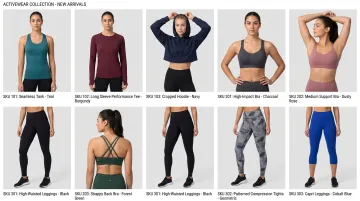
Across hundreds of SKUs, maintaining consistent framing, background tone, and quality becomes nearly impossible manually. AI generates every image with uniform framing, background treatment, and lighting — so a 200-SKU catalog holds the same professional aesthetic throughout, critical for cohesive brand presentation across e-commerce platforms and lookbooks.
Quality Assurance Through Human Review
The critical difference between enterprise-grade AI platforms and consumer tools lies in quality assurance. Platforms like MetaModels.ai use human-verified image checking: every AI-generated image is reviewed by fashion specialists who catch garment rendering errors — distorted logos, misrepresented seam details, incorrect print placement, and colour inaccuracy — before images go live.
This hybrid AI + human workflow means brands get catalog-ready images at scale, without trading speed for accuracy.
How to Create an AI-Powered Activewear Catalog: Step-by-Step
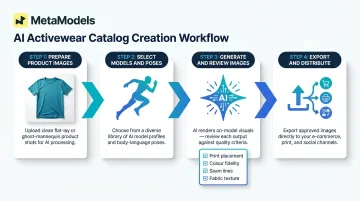
Prepare Your Product Images
What makes a good input image:
- Clean flat-lay on plain background (white or neutral grey)
- Good lighting that shows fabric texture and sheen
- Wrinkle-free garment presentation
- Ghost mannequin shots work well and typically deliver better fabric draping results
Organise before uploading:
Group SKUs by category (sports bra, legging, jacket) and colorway rather than uploading randomly. Batching by category streamlines the AI generation workflow and makes final file management easier.
Select Your Models and Poses
With your images prepared, the next step is choosing who wears them.
Model selection:
Most AI platforms offer curated libraries of models across ethnicity, body type, age, and demographics. Select a model set that reflects your brand's target customer and diversity goals.
Platforms like MetaModels.ai also offer custom model creation if you need a specific look or consistent brand identity maintained across the entire catalog, which is particularly useful for brands building a consistent visual identity across channels.
Pose selection for activewear:
- Action-oriented poses work well for social content and campaign imagery where performance intent needs to come through
- Standing poses suit e-commerce thumbnails and product detail pages where clarity matters most
- Mixed approach: Select 2-3 poses per garment type — one clean e-commerce angle, one lifestyle or action shot
Generate, Review, and Export
Once your models and poses are confirmed, generation is fast — but a structured review pass keeps quality consistent.
Generation and review loop:
After generating images, review each for garment accuracy before approving for catalog use:
- Print placement and alignment
- Colour fidelity to original product
- Seam lines and construction details
- Fabric texture rendering
Human review at this stage prevents errors from reaching product pages or printed lookbooks.
Output formats and resolution:
Catalog images typically need 4K resolution for print lookbooks and high-resolution e-commerce product pages. Confirm output specs before exporting — MetaModels.ai delivers ready-to-post content up to 4K resolution.
Organise and distribute final images:
Use structured file naming by SKU and model variant. Consistent naming makes downstream distribution straightforward:
- Uploading to e-commerce platforms by product SKU
- Handing off to design teams for lookbook layouts
- Scheduling across social media content calendars
Showcasing Diversity and Inclusivity in Activewear Catalogs with AI
Inclusivity matters more in activewear than in most fashion categories. Shoppers buying performance gear want to see how compression fits on bodies that look like theirs, how high-waisted leggings sit across different torso lengths, how sports bras support various body types.
Research demonstrates that own-size model photography mitigates fit risk and enhances purchase decisions. When model body size differs significantly from the shopper's, perceived similarity drops, fit risk increases, and purchase intention declines. Critically, the study found no downside — in none of 11 studies did own-size photography negatively affect purchase decisions compared to thin-size photography.
AI Removes Practical Barriers to Representation
Traditional shoots require booking multiple models to represent diverse body types — each model adding $800–$1,500 to the shoot cost, plus fitting time and schedule coordination.
AI platforms with diverse model libraries let brands generate the same SKU on multiple body types at no additional cost per image. One product input generates imagery across five body types simultaneously.
This transforms inclusivity from a budget-constrained campaign decision into a scalable, ongoing content strategy.
Brand Equity Benefit
Activewear brands that visibly represent a range of bodies and demographics build stronger community loyalty. When 95.5% of fashion runway looks remain straight-size, brands that authentically showcase diversity stand out.
AI makes this operationally sustainable across the full catalog cycle:
- Seasonal lookbooks with consistent representation across all body types
- New product launches that don't require additional model bookings
- Colorway variations covered without incremental shoot costs
Choosing the Right AI Tool for Your Activewear Catalog
Key Capabilities to Evaluate
- Fabric draping accuracy — fashion-specific AI trained on clothing handles stretch and compression fabrics; general-purpose tools typically don't
- Model library diversity — check ethnicity range, body type representation, and age spread against your target customer demographics
- Resolution output — minimum 4K for catalog use; confirm export formats suit your e-commerce platform and any print requirements
- Batch processing — high-volume SKU sets need bulk upload capabilities and, for enterprise use, API access for workflow integration
- Human review options — automated-only output risks publishing distorted garment details; QA review catches rendering errors before delivery
What Separates Fashion-Specific AI from General Tools
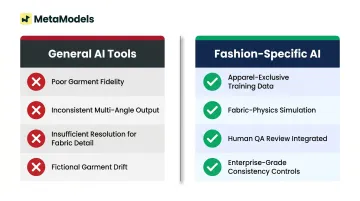
General AI image tools handle backgrounds and scenes well but struggle with garment fidelity on performance fabrics. The Fstoppers independent review found consumer-grade tools failed to maintain outfit consistency across standard front, side, and back angles, produced insufficient resolution for detailed fabric inspection, and created "fictional garments" that drifted from originals.
Fashion-specific platforms address these gaps through:
- Training data focused exclusively on apparel and fashion imagery
- Fabric-physics simulation for realistic drape and movement
- Human QA review integrated into delivery workflow
- Enterprise-grade consistency controls for multi-angle catalog requirements
MetaModels.ai: Purpose-Built for Activewear Catalogs
If those criteria define what you need, MetaModels.ai is built to meet them. The platform combines real-time fabric draping technology with a curated diverse model library, custom model creation, and human-verified 4K output — covering the full production workflow without traditional photoshoot overhead.
It accurately renders stretch fabrics, moisture-wicking textures, compression fits, and athletic silhouettes across activewear categories including jerseys, leggings, sports bras, tracksuits, and gym wear. Every image is reviewed by human fashion specialists who verify colour, shape, proportions, and garment details before delivery.
Pricing starts from £20 per image, with subscription tiers offering volume discounts for brands producing at scale.
Frequently Asked Questions
Can AI create a catalog?
Yes, AI tools generate on-model product images, organise them by SKU, and produce catalog-ready content at scale. Human oversight for brand consistency and garment accuracy is recommended before publishing.
How does AI handle activewear fabrics like compression or mesh?
Advanced AI platforms use fabric draping technology that simulates how stretch and technical materials behave on the body, preserving texture, sheen, compression fit, and mesh transparency in the generated image.
How much does AI activewear photography cost compared to a traditional shoot?
Traditional shoots cost £125-£250 per product image when factoring in model fees, studio rental, photographer rates, and retouching. AI generation costs £0.50-£1.50 per image — a 95%+ cost reduction at enterprise scale.
Can AI generate multiple body types for the same activewear garment?
Yes, AI platforms with diverse model libraries generate the same garment on multiple body types, skin tones, and demographics from a single product image input.
How many images can I generate for an activewear catalog using AI?
MetaModels.ai offers plans from 20 to 300+ images monthly, and brands with 100+ SKUs can generate full catalog coverage in hours rather than weeks. AI removes the per-image cost barrier entirely, making high-volume production accessible at any scale.
Is AI-generated activewear photography realistic enough for e-commerce product pages?
With fabric-specific AI and human review in the workflow, output quality now matches studio photography for most activewear garment types. AI renders print details, seam lines, compression fit, and fabric texture accurately at 4K resolution — suitable for professional e-commerce and print catalog use.