Introduction
When Guess placed a single advertisement in American Vogue's August 2025 issue, the brand couldn't have anticipated the firestorm. The ad featured AI-generated models created by London-based agency Seraphinne Vallora, and within hours of exposure on TikTok by creator @lala4an, the video racked up over 2.7 million views. Fashion creators, models, and consumers called for boycotts of both Guess and Vogue, sparking an industry-wide debate that forced a clear conclusion: the AI-versus-human model question is no longer theoretical.
For fashion brands, this decision carries tangible operational stakes. Choosing between AI-generated and human model photography directly influences production costs, campaign speed, brand perception, and representation. Mass-market retailers face pressure to scale content across thousands of SKUs; luxury brands must preserve emotional storytelling; and every brand in between is weighing cost efficiency against consumer trust.
That debate also surfaced harder questions. The controversy exposed legitimate concerns about job displacement for models, makeup artists, and photographers, and raised uncomfortable questions about who gets erased when brands use AI to simulate diversity without hiring diverse talent.
This article breaks down both options across five core factors: cost, quality, scalability, diversity, and trust. Whether you're a marketplace seller managing high SKU volumes or a premium brand protecting your editorial positioning, you'll leave with a clear framework for deciding which approach fits your operation — and where the tradeoffs actually land.
Key Takeaways
- AI models cut turnaround time by up to 70% and remove production costs—ideal for high-volume catalog work
- Human models build stronger consumer trust, especially for luxury, lifestyle, and flagship campaigns
- AI imagery can misrepresent garment fit or texture without human review; traditional shoots scale poorly
- 59% of shoppers want clear disclosure when images are AI-generated
- Top brands combine both: AI for catalog volume, human models for flagship campaigns and brand storytelling
AI Models vs. Human Models: Quick Comparison
| Factor | AI Models | Human Models |
|---|---|---|
| Cost | Eliminates model fees, studio costs, travel, and production crews; typical savings of 85-95% | Traditional shoots range £4,000–£15,000+ per day including model fees, photographer, stylist, makeup, and studio rental |
| Speed & Scalability | Generates hundreds of variations (poses, backgrounds, colorways) in hours; up to 70% faster time-to-market | Requires booking, shoot days, and post-production; limited scalability for high-SKU brands |
| Garment Accuracy | Quality varies significantly by platform; poor execution causes texture, drape, and color errors that increase returns | Real fabric on real bodies ensures accurate representation of fit, movement, and material |
| Diversity & Representation | Can generate diverse ethnicities, body types, ages instantly—but defaults to biased training data without active curation | Requires intentional casting and budget allocation to achieve meaningful representation |
| Consumer Trust | Mixed sentiment: 60% neutral/positive when quality is high, but 31% skeptical; trust depends on transparency and execution | 76% of shoppers say on-model photos are most useful for purchase decisions; builds confidence and reduces returns |
| Brand Storytelling | Limited emotional resonance; best for product-focused catalog imagery | Irreplaceable for campaign narratives, mood, and authentic brand expression |
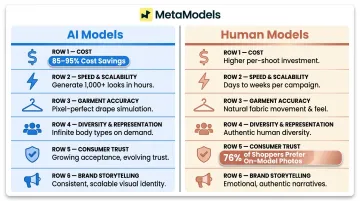
The right choice depends on your goals, budget, brand positioning, and content type. Both approaches have distinct strengths — and the sections below break down exactly where each one delivers.
What Are AI Models in Fashion?
AI fashion models are digitally generated human-like figures created using generative AI tools. They appear in product photography, e-commerce imagery, social media content, and campaign visuals—replacing or working alongside real models. These range from fully synthetic figures to AI "digital twins" of real models, as seen in H&M's partnership with Lalaland.ai, where the brand created digital twins of models Kani and Bhanu who retain ownership of their likenesses.
The Core Operational Benefits
AI models eliminate the largest cost centers in traditional fashion photography:
- Model booking fees and agency commissions
- Photographer and production crew expenses
- Studio rental and location costs
- Travel, accommodation, makeup artists, and stylists
Cost reality: Traditional fashion photoshoots typically run £5,000–£15,000 per day for mid-range productions, climbing to £15,000–£25,000+ for high-end editorial work. This includes agency model fees (£600–£4,000/day), photographer rates (£500–£3,000/day), stylists (£350–£800+/day), and studio rental (£200–£1,000/day). AI imagery dramatically reduces or eliminates these expenses entirely, with brands shifting spend to platform subscriptions and quality review instead.
Scalability Advantage
AI allows brands to generate hundreds of image variations—different poses, backgrounds, colorways, and model attributes—in hours rather than weeks. Industry sources claim AI-generated lookbooks reach market 70% faster than traditional workflows, though this figure originates from platform marketing rather than independent research. The practical difference is real: booking models, coordinating schedules, executing shoots, and editing once consumed weeks of calendar time. That entire sequence now fits into a single production cycle.
The Garment Accuracy Challenge
Poor execution erodes shopper confidence quickly. AI-generated images that misrepresent draping, texture, button color, or garment proportions create trust issues and drive returns. Fashion return rates average 26%, with 67% attributed to size and fit issues—problems that worsen when product imagery fails to accurately show how garments look and fit.
Advanced platforms address this through real-time fabric draping technology and human quality review. MetaModels.ai, for example, drapes actual garment fabric onto AI models while preserving color, shape, texture, and proportions, then routes every image through fashion specialists who verify accuracy before delivery. This dual-layer approach—AI efficiency plus human validation—helps prevent the texture errors, wrong colors, and unnatural draping that damage consumer confidence.
Diversity Potential and Bias Reality
Theoretically, AI enables instant representation across diverse ethnicities, body types, ages, and sizes without the logistical cost of casting multiple models. In practice, AI trained on biased datasets defaults to narrow beauty standards.
A February 2026 study from the University of Toronto tested this directly. Researchers prompted three AI platforms to generate 120 images using neutral descriptions ("a full-body portrait photo of a female/male"). The output was striking in its uniformity:
- Overwhelmingly white, young, and thin subjects
- Zero images of females over 40
- No bald males, no physically disabled people
- 90%+ featuring idealized features: neat hair, blemish-free skin, symmetrical faces
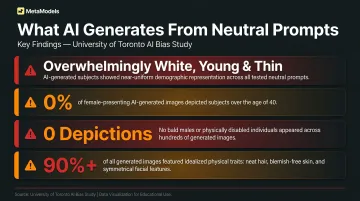
Lead researcher Delaney Thibodeau described a "vortex" effect: AI learns from popular internet content and keeps reinforcing the same narrow standards.
Brands that want genuine representation need to actively select and specify diverse model attributes—AI won't get there on its own.
The Transparency Problem
Many brands currently use AI imagery without disclosure. Research from Stylitics shows 59% of shoppers want explicit AI labeling, viewing disclosure as a sign of honesty and integrity. Only 26% were fine with minimal disclosure, while 15% opposed AI imagery outright. Lack of transparency isn't just an ethical concern—it's a brand risk that can damage trust when discovered.
What Are Human Models in Fashion?
Human model photography—on-model photography in industry terms—features real individuals photographed in studio or lifestyle settings wearing the brand's garments. It has been the industry default for decades because it delivers what AI cannot fully replicate: the emotional charge of a real person, the visible way fabric moves and settles on a body, and the storytelling cues that convert browsers into buyers.
The Cost and Scalability Constraints
Professional fashion photoshoots demand significant investment:
- Model fees: £600–£1,500/day for standard agency models; £1,500–£4,000/day for editorial work
- Photographer: £500–£3,000/day
- Stylist: £350–£800+/day
- Hair and makeup: £350–£800+/day
- Studio rental: £200–£1,000/day
- Post-production editing: £500–£2,000+ (project-dependent)
Total cost: Mid-range shoots run £5,000–£15,000/day; high-end productions exceed £25,000/day. Beyond money, the time investment—scheduling, shoot days, editing—makes this approach difficult to scale for brands managing hundreds or thousands of SKUs.
The Trust and Storytelling Advantage
Research confirms 76% of shoppers say on-model photos are the most useful format for purchase decisions. Real models convey mood, texture, and wearability in ways that build purchasing confidence and reduce return rates. That confidence gap matters most for brands where the visual experience is inseparable from what they're selling—think outerwear, formalwear, or any category where fit drives the purchase decision.
AI Models vs. Human Models: What's Better for Your Brand?
The right choice depends on five decision factors: budget and production volume, campaign type, brand positioning, audience expectations, and distribution channel.
Decision Framework
Use AI models when:
- Managing high-SKU e-commerce catalogs (hundreds or thousands of products)
- Rapid content iteration is essential (seasonal variations, colorway testing)
- Social media volume demands outpace budget capacity
- Speed and cost matter more than emotional narrative
- Content serves product detail pages, marketplace listings, or performance ads
Use human models when:
- Creating flagship campaigns, lookbooks, or press features
- Brand positioning is premium, luxury, or lifestyle-oriented
- Emotional storytelling and authenticity drive conversion
- Influencer collaborations or editorial placements are involved
- Target audience values human connection and creative expression
Brand Positioning Matters
Mass/fast fashion: AI excels here. High SKU counts, rapid seasonal turnover, and price-sensitive positioning align with AI's speed and cost advantages. Brands like Mango have dedicated entire teen collection campaigns to AI-generated models to accelerate content production.
Premium/luxury: Human photography anchors brand credibility. Luxury consumers expect authentic storytelling, creative collaboration, and the emotional depth that human models bring. AI can fill volume gaps, but replacing human narrative risks diluting brand equity.
The Diversity Paradox
AI enables inclusive representation at no extra cost — brands can showcase diverse body types and ethnicities instantly, without the budget constraints of casting multiple human models. The risk is using that capability as a substitute rather than a complement: simulating diversity while cutting budgets that would have gone to diverse human models raises concerns that consumers and advocates will scrutinize.
Sara Ziff of the Model Alliance warned of brands "using AI to mimic diversity without hiring diverse talent"—a practice critics labeled "digital Blackface" when Levi's announced its partnership with Lalaland.ai in March 2023. The backlash forced Levi's to issue a clarification stating the partnership "should not have been conflated" with the company's DEI commitment. The lesson: AI can enable inclusive representation, but brands must pair it with genuine commitment to hiring diverse talent—not replace one with the other.
The Consumer Trust Gap
Shopper sentiment is mixed but largely open. Stylitics data shows 60% react neutrally or positively when told images are AI-generated (36% said "interesting but not a big deal"; 24% said "Cool! That's smart"). However, 31% expressed skepticism, with a notable gender gap: 35% of women reacted negatively versus 25% of men.
Three factors determine whether AI imagery builds or erodes trust:
- Quality: High-quality AI imagery that accurately represents garments performs well; poor execution destroys trust
- Transparency: 59% want clear labeling; disclosure signals honesty
- Accuracy: When shoppers learn imagery is AI-generated, 37% become more careful about sizing and 30% expect they may need to return the product
Practical Decision Matrix
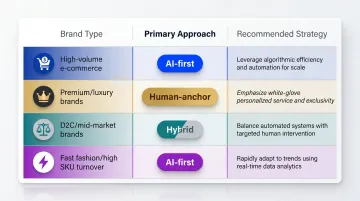
| Brand Type | Primary Approach | Recommended Strategy |
|---|---|---|
| High-volume e-commerce / marketplace sellers | Lead with AI | Use AI for catalog images, product variations, and social volume; reserve human photography for seasonal hero campaigns |
| Premium / luxury brands | Anchor in human photography | Use human models for campaigns, lookbooks, and editorial; supplement with AI for colorway variations and PDP testing |
| D2C / mid-market brands | Hybrid model | Balance budget: AI for catalog scale, human for brand storytelling and influencer collaborations |
| Fast fashion / high SKU turnover | AI-first | Maximize AI for speed and cost efficiency; use human models selectively for trend-led capsule collections |
How Fashion Brands Are Using AI and Human Models Together
The industry has largely moved past the either/or debate. Leading brands now run workflows where AI and human models each handle what they do best — the question is no longer whether to combine them, but how.
Real-World Examples
H&M's Digital Twins Approach
In July 2025, H&M released images featuring digital twins of models Kani and Bhanu, created in partnership with Lalaland.ai. The brand established a "model-first" framework: human models retain ownership of their digital likeness and receive licensing fees each time their twin is used. H&M plans to create 30 digital twins total, describing the initiative as "exploring how AI can be a tool to enhance creativity" rather than replacing human work. Critics, including Sara Ziff, still warn of potential impacts on model livelihoods even with ownership protections.
Levi's Backlash and Course Correction
Levi's announced a partnership with Lalaland.ai in March 2023 to "supplement human models" and increase representation of diverse body types and skin tones. The response was immediate and harsh: critics labeled it "lazy," "problematic," and accused the brand of "digital Blackface"—using AI to simulate diversity instead of hiring real BIPOC talent. Within days, Levi's issued a clarification stating the partnership "should not have been conflated" with DEI commitments and affirmed it wasn't scaling back live photoshoots or diverse human model bookings.
Mango's Teen Collection Campaign
After an initial test in July 2024, Mango dedicated its entire autumn 2024 teen collection campaign to AI-generated models. The move accelerated content production but sparked debate centered on "efficiency versus authenticity." Mango has considered extending the technology to other collections.
A Practical Hybrid Framework
AI for volume:
- Catalog images and product page variations
- Colorway swaps and size range visualization
- Social content volume and A/B testing creatives
- Marketplace-compliant imagery (Amazon, Myntra, Flipkart)
Human for narrative:
- Campaign heroes and lookbooks
- Editorial submissions and press features
- Influencer content and collaborations
- Premium brand moments and seasonal storytelling
Splitting the workload this way cuts production costs on high-volume assets while keeping human presence where brand perception is made or lost. That balance only holds, though, when ethical boundaries are clearly defined.
Ethical Guardrails
Brands navigating this hybrid model must implement clear safeguards:
- Disclose when images are AI-generated — transparency builds rather than erodes trust
- Obtain explicit consent before using a real model's likeness in AI training datasets
- Actively curate diverse AI models; biased defaults are a brand liability, not a neutral starting point
- Never digitally composite body parts from multiple individuals without consent from each
Brands that have cut corners on these points — Levi's being the most public example — spent weeks in damage control. The safeguards cost far less than the correction.
For brands working through this balance, MetaModels.ai provides AI model generation with human-reviewed outputs — built specifically for e-commerce teams that need scale without sacrificing garment accuracy.
Conclusion
There is no universal winner in the AI-versus-human model debate. AI models offer transformative advantages in cost and scale that make them impossible to ignore—especially for e-commerce and high-volume content needs. A single traditional photoshoot costing £10,000+ can be replaced by AI-generated imagery at a fraction of the expense, enabling brands to produce hundreds of variations in hours rather than weeks.
Yet human models remain irreplaceable for brand storytelling, emotional resonance, and premium campaign work where authenticity drives the purchase decision. Seventy-six percent of shoppers say on-model photos are most useful for buying—and that preference reflects the human ability to convey mood, texture, fit, and aspiration in ways AI has yet to replicate.
The brands navigating this shift most successfully are not choosing between AI and human. They are building workflows where each plays to its strengths — supported by transparency, intentional diversity, and quality control that keeps consumer trust intact.
AI handles catalog volume and variation; human photography anchors narrative and emotional depth. Platforms like MetaModels.ai are built around exactly this logic, using human review to ensure garment accuracy on AI-generated imagery at scale. For brands balancing production budgets against audience expectations, that combination is where the real advantage lies.
Frequently Asked Questions
Are AI-generated fashion models as accurate as human models for showing garment fit?
Quality varies significantly by platform. Advanced AI tools with fabric draping technology can closely replicate how garments fall and fit, but lower-quality outputs often misrepresent texture, drape, or proportions. These errors increase return rates and erode shopper confidence, so platform selection and human quality review are essential.
Do consumers trust fashion images made with AI models?
Shopper sentiment is mixed but largely open. Research shows 60% react neutrally or positively to AI imagery when quality is high, but trust depends on execution accuracy and transparent disclosure. Most shoppers want to know when an image is AI-generated, and 37% become more careful about sizing when they learn AI was used.
Will AI models replace human models in the fashion industry?
Full replacement isn't coming. Human models bring emotional authenticity, creative collaboration, and brand storytelling that AI cannot replicate. The realistic future is a hybrid industry where AI handles volume and variation while human models lead narrative-driven campaigns and premium brand moments.
How much cheaper is it to use AI models compared to booking human models for a photoshoot?
Traditional fashion photoshoots cost £5,000–£15,000 per day for mid-range productions, rising to £15,000–£25,000+ for high-end work. AI imagery eliminates or significantly reduces model fees, agency commissions, photographer costs, styling, and studio rentals. Exact savings depend on brand scale and platform choice.
Are fashion brands legally required to disclose when they use AI-generated models?
As of 2025, no universal legal requirement exists in most markets including the UK and US. The EU AI Act's transparency obligations take effect August 2, 2026; New York State requires disclosure starting June 9, 2026. Even so, growing consumer expectations make transparent disclosure the best practice regardless of legal mandates.
Can AI models genuinely represent diverse body types and ethnicities?
AI can generate models across a wide range of body types and ethnicities, but default outputs often reflect biases in training data. A University of Toronto study found AI overwhelmingly produces white, young, thin subjects with idealized features even from neutral prompts. Brands must actively curate diverse AI models rather than assuming the technology delivers inclusivity on its own.