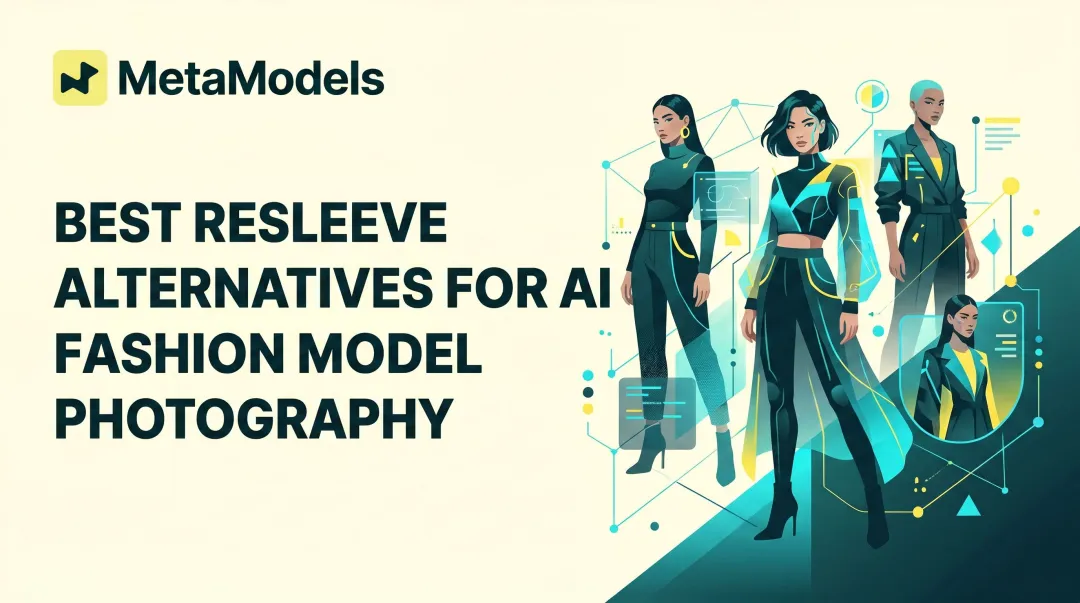
AI virtual try-on technology has moved from experimental novelty to operational necessity in 2026. Early adopters report measurable results: Zalando documented a 40% drop in returns following its virtual try-on pilot in April 2023. Meanwhile, 76% of shoppers state that on-model photos are the most useful format for making buying decisions—validating the core value proposition of AI model imagery.
This guide compares five leading AI platforms for virtual try-ons in fashion, covering garment accuracy, model diversity, pricing, and scalability. Whether you're a D2C brand launching your first catalog or an enterprise retailer managing thousands of SKUs, you'll find a structured framework to make an informed choice.
Key Takeaways
- AI virtual try-on platforms convert flat-lay or packshot photos into on-model product images—no photoshoots, no model bookings required
- Top platforms in 2026 differ on drape accuracy, batch capacity, and marketplace compliance (white backgrounds, 1,600px+ resolution)
- MetaModels.ai delivers human-reviewed AI model imagery at scale — no royalties, no model rights complications
- Fashn excels at draping intricate prints and structured garments
- Uwear handles high-volume batch processing up to 10,000 items
- Choose based on catalog size, quality review needs, and whether you want a self-serve tool or managed content production service
AI Virtual Try-On in Fashion: What It Is and Why It Matters
AI virtual try-on is technology that uses diffusion models and garment-alignment rendering to digitally place clothing on model images, simulating how a garment looks when worn. The technology serves two primary use cases: brand-side catalog imagery generation (replacing traditional photoshoots) and shopper-facing interactive try-on (letting customers see products on their own digital avatar or diverse model options).
76% of shoppers want to see products on real models before purchasing. Yet traditional fashion photography costs $100–$500+ per on-model image, with full sessions running $500–$10,000 depending on production scope. Returns compound the problem: processing each return costs over 21% of the order's value, according to Happy Returns data.
Virtual try-on addresses both issues. The same Zalando pilot that cut returns by 40% also confirmed that AI-generated catalog imagery has reached commercial viability: 71% of shoppers could not distinguish real from AI-generated apparel images in blind tests.
As the market has matured, platform quality varies enormously across garment fidelity, model diversity, and production scalability. The profiles below compare the five platforms serving fashion brands in 2026 across these dimensions.
Best AI Platforms for Virtual Try-Ons in Fashion (2026)
These five platforms were selected based on output quality, garment rendering accuracy, model diversity, scalability, and real-world suitability for fashion e-commerce workflows—ranging from managed services to developer-ready APIs.
MetaModels.ai
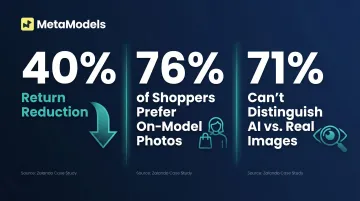
MetaModels.ai is an AI-powered fashion imagery platform that converts packshots and flat-lays into professional on-model content without physical photoshoots. The platform maintains a curated library of diverse AI models covering varied ethnicity, body types, and demographics, with custom model creation capability for brands requiring consistent brand identity across catalogs. Unlike fully automated tools, MetaModels implements end-to-end production management with human-reviewed outputs before delivery, ensuring garment details pass quality checks.
The differentiating layer is human-verified quality assurance. Every generated image undergoes review by fashion specialists who check color accuracy, shape and proportions, and garment-specific details—catching subtle errors that automated tools often ship at scale.
The platform's real-time fabric draping technology preserves texture, print detail, and color fidelity. Output is delivered ready-to-post at 4K resolution across all pricing tiers, with zero model royalties or usage rights complications—making it a strong fit for brands scaling content across e-commerce, social media, ads, and lookbooks where garment accuracy is non-negotiable.
| Dimension | Details |
|---|---|
| Key Features | Diverse AI model library; custom brand model creation; real-time fabric draping; human-reviewed outputs; 4K resolution; packshot-to-model conversion; unlimited commercial usage rights with zero royalties |
| Best For | Fashion brands and e-commerce companies needing brand-consistent, high-quality AI model imagery at scale with a managed production layer and zero model booking overhead |
| Pricing | Subscription-based starting at 20 image credits; Growth plan 100 credits; Pro plan 300 credits; Enterprise custom pricing with API access |
Fashn
Fashn is a specialist virtual try-on platform built around its proprietary v1.5 garment rendering architecture. Its core workflows—Product to Model, Model Swap, and Virtual Try-On—focus on producing the most accurate fabric drape and texture preservation available in the self-serve category. Fashn's architecture regenerates the full image with coherent lighting, shadows, and fabric physics rather than overlaying a garment on an existing photo.
On garment accuracy specifically, the platform reduces visible artifacts around necklines, sleeve joints, and printed details—the failure points that erode buyer trust in AI-generated imagery. Native 4K output is available starting on the Basic tier at $19/month, with API access for developer integration. The trade-off is narrow scope: Fashn doesn't offer lifestyle scene generation or style-extraction workflows, positioning it as a specialist tool for brands prioritizing flatlay-to-model conversion quality above feature breadth.
| Dimension | Details |
|---|---|
| Key Features | Proprietary v1.5 rendering engine; Product to Model, Model Swap, Virtual Try-On workflows; AI model creation and reuse; 4K resolution on all paid tiers; API access (separate pricing) |
| Best For | Brands prioritizing flatlay-to-model conversion accuracy above all else; specialist draping quality for detailed prints, sheer fabrics, or structured garments |
| Pricing | Free tier (10 one-time credits); Basic $19/month (200 credits); Pro $49/month (750 credits + 50 daily); Agency $99/month (1,500 credits + 100 daily); top-ups $0.10/credit |
WearView
WearView is a comprehensive AI fashion content platform combining virtual try-on, text-to-model generation, AI model creation, pose control, consistent model identity, and video generation in a single workspace. It accepts garment input from flat-lays, ghost mannequin shots, packshots, or on-person photos, outputting up to 4K resolution. The platform has served 19,000+ brands and generates images in approximately 15 seconds.
WearView's key differentiator is breadth of workflow coverage. Brands can handle the full content pipeline—try-on imagery, catalog consistency via model identity lock, social video from stills—without switching tools. The consistent identity feature maintains the same AI model face and body across an entire catalog, addressing visual coherence at scale. Team collaboration (up to 15 seats on Advanced plan) makes WearView viable for agencies managing multiple fashion clients. Credit consumption varies by quality: HD costs 1 credit, 2K costs 3 credits, 4K costs 5 credits per image.
| Dimension | Details |
|---|---|
| Key Features | Text-to-model generation; virtual try-on from multiple garment formats; consistent model identity across catalog; AI video generation (720p-1080p); pose control via reference images; 4K output; 100+ diverse models |
| Best For | E-commerce brands and agencies needing a full content pipeline—model creation, try-on, video, and catalog consistency—in one platform |
| Pricing | Lite $24/month (50 credits); Pro $40/month (200 credits); Advanced $82/month (500 credits); annual billing saves $58-$198; 100% money-back guarantee |
Uwear
Uwear is a high-volume batch processing platform built around its proprietary Drape AI engine, which regenerates entire garment images from scratch for coherent lighting and fabric texture rather than overlaying clothing on a base image. The platform supports CSV-based batch uploads of up to 10,000 items in a single run, making it purpose-built for large catalog operations.
Uwear's core strength is the combination of specialist garment rendering and enterprise-scale batch throughput unmatched in the category. Pay-as-you-go pricing at $0.10/credit with non-expiring credits suits brands with seasonal volume spikes or irregular production schedules.
The platform also offers a consumer-facing "Try On You" feature for shopper-side try-on, where customers create a persistent profile (reference photo + body measurements) usable across all stores running Uwear. Two limitations to note: base resolution requires upscaling for 4K output, and there's no text-to-model generation capability.
| Dimension | Details |
|---|---|
| Key Features | Proprietary Drape AI engine; batch processing up to 10,000 items via CSV; pay-as-you-go non-expiring credits; video generation; API access; consumer-facing Try On You feature; multi-angle shots in single batch run |
| Best For | Large fashion brands and wholesale operations launching hundreds or thousands of SKUs simultaneously who need reliable garment rendering at scale without subscription lock-in |
| Pricing | Pay-as-you-go at $0.10/credit (credits never expire); no monthly subscription required; free starter credits on signup; virtual try-on priced per-shopper for merchant integration |
Reactive Reality (PICTOFiT)
Reactive Reality and its PICTOFiT platform deliver an enterprise-grade shopper-facing virtual try-on solution that enables customers to create personalized digital avatars from a selfie and basic measurements, then try garments on their own digital twin in 2D or 3D. Unlike the catalog-side tools above, PICTOFiT targets the consumer fitting room experience rather than marketing asset creation.
For shopper-facing deployment, the personalized avatar narrows the gap between digital browsing and real-world fit confidence—leading to higher engagement, longer session times, and measurable return rate reductions reported by brands including H&M, Hugo Boss, Walmart, and Zalando.
Its SDK enables omnichannel embedding across web, mobile apps, and in-store smart mirrors. The platform is enterprise-priced and requires integration work, making it better suited for mid-to-large brands with development resources than solo sellers or small brands.
| Dimension | Details |
|---|---|
| Key Features | Personalized digital avatar creation (selfie + measurements); 2D and 3D garment try-on; product digitization into smart digital assets; omnichannel SDK (web, app, in-store); outfit layering and mix-and-match |
| Best For | Mid-to-large fashion retailers wanting to offer customers a personalized, shopper-facing fitting room experience on their website, app, or in-store smart mirrors |
| Pricing | Enterprise pricing via custom quote; no public self-serve or SMB tier available; contact sales for detailed pricing and integration requirements |
How We Chose the Best AI Virtual Try-On Platforms
This evaluation focused on the three outcomes fashion brands actually care about: reducing returns, improving conversion rates, and replacing or supplementing photoshoot costs. A common mistake when choosing a platform is judging single-image quality without stress-testing consistency across a full catalog batch of 50–100 SKUs — that's where most tools fall apart.
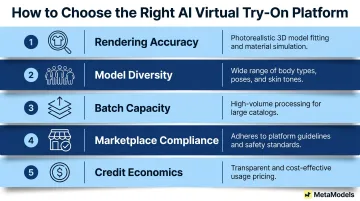
That real-world pressure shaped five selection criteria:
Rendering Accuracy — Does the platform preserve print detail, fabric texture, and drape without artifacts around necklines, sleeve joints, or small text logos? Specialist engines (Fashn's v1.5, Uwear's Drape AI) outperform generic diffusion models on structured garments and sheer fabrics.
Model Diversity — Coverage across ethnicity, body types, and age ranges to serve global audiences and meet emerging inclusion standards. Platforms with curated libraries (MetaModels, WearView's 100+ models) reduce the manual work of sourcing representative imagery.
Batch Capacity — Can the platform handle catalog-scale operations efficiently? Uwear's 10,000-item CSV batch capability serves enterprise needs; subscription tools like Fashn and WearView suit moderate volumes with predictable monthly credit allocations.
Marketplace Compliance — Output must meet Amazon's RGB-255 pure white background standard and minimum 1,600px resolution for zoom functionality. Platforms built for marketplace sellers (MetaModels, Uwear) guarantee this; others may output near-white backgrounds (RGB-252) requiring post-processing.
Credit Economics — Per-image cost matters less than how the pricing model fits your actual usage pattern. A $19/month plan with 200 credits works out to $0.095 per image — but only beats a $0.10 pay-as-you-go rate if you use all 200 credits every month. Uwear's non-expiring credits suit seasonal brands; subscriptions suit consistent-volume operations.
The threshold separating enterprise-grade tools from experimental prototypes: output that passes a blind quality test against real product images. Platforms with human review layers — like MetaModels' quality verification step — consistently clear this bar where fully automated tools don't.
Conclusion
The right AI virtual try-on platform is not the one with the most features—it's the one that fits your catalog size, workflow structure, and quality standards. A managed service with human review like MetaModels.ai suits brands that cannot afford QA errors at scale or need guaranteed marketplace compliance. Specialist tools like Fashn or Uwear suit teams with in-house review capacity who prioritize garment accuracy or batch throughput above workflow breadth.
Before committing to a paid plan, pressure-test any shortlisted platform with your 10 hardest SKUs (sheer fabrics, intricate prints, small logo details). Per-image pricing rarely tells the full story. Factor in:
- Regeneration rates — how often outputs need to be rerun before they're usable
- Hidden labor costs — internal QA time that doesn't appear on the platform invoice
- First-pass yield — a $0.10/image service requiring 30% rework costs more than a $0.20/image service delivering publication-ready output first time
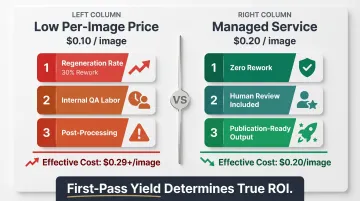
That first-pass yield is where managed services tend to justify their price premium. Brands that want to eliminate model booking costs, royalties, and photoshoot logistics entirely can explore MetaModels.ai's managed AI model imagery service — outputs are human-reviewed for garment accuracy, delivered at 4K resolution, and carry no usage restrictions.
Frequently Asked Questions
What is AI virtual try-on and how does it work for fashion brands?
AI virtual try-on uses diffusion models and garment-alignment rendering to digitally place clothing onto model images, preserving fabric texture, drape, and color from a flat-lay or packshot input. The output works for both brand catalog production and shopper-facing fitting room experiences.
How much does AI virtual try-on cost compared to traditional model photography?
Traditional fashion photoshoots cost $100–$500 per SKU — covering model, photographer, studio, and retouching — with full sessions reaching $500–$10,000. AI virtual try-on platforms run $0.10 to over $1 per image depending on tool and resolution tier, representing 80–95% savings for most mid-market brands.
Which AI virtual try-on platform is best for large-catalog e-commerce brands?
It depends on your priority:
- Uwear — raw batch throughput (up to 10,000 items via CSV) for pure volume
- MetaModels.ai — managed, brand-consistent output with human review at scale
- WearView — catalog-wide model consistency plus video in one workflow
Choose based on whether you need volume, quality assurance, or workflow breadth.
Can AI-generated virtual try-on images meet Amazon and Shopify listing requirements?
Leading platforms output images meeting Amazon's minimum 1,600px requirement and RGB-255 pure white background standard. Verify each platform's compliance guarantee before committing, as some tools output near-white backgrounds (RGB-252) requiring post-processing.
How do I ensure garment accuracy in AI virtual try-on output?
Clean, well-lit flat-lay images on plain white backgrounds produce the best input quality. Platforms with specialist draping engines (Fashn, Uwear's Drape AI) or human review layers (MetaModels.ai) produce the most accurate garment detail preservation, especially for prints, logos, and structured fabric.
What is the difference between AI virtual try-on and AI fashion model generation?
Virtual try-on places a specific garment onto an existing model image, while AI fashion model generation creates a full model image from scratch using a text prompt or garment input. Many platforms now combine both workflows; specialist tools like Fashn focus exclusively on try-on transfer, while MetaModels.ai and WearView cover both.