Introduction
Fashion brands face a recurring problem: creating engaging video content that viewers love but that rarely converts into sales. A customer watches a styling tutorial, admires the outfit, then abandons the journey when they can't immediately find the product—or worse, when the purchase process requires leaving the video, opening a browser, and hunting through a website.
Shoppable video content solves this conversion gap by embedding clickable product links directly into fashion videos, letting viewers purchase without leaving the content. According to 2025 data, fashion e-commerce sites with shoppable video achieve conversion rates up to 80% higher than static product pages.
The results, though, aren't automatic. Visual quality, content format, platform choice, and how products are tagged all determine whether a shoppable video drives purchases or gets skipped.
This guide covers the full creation process: content strategy, production essentials, platform selection, and the formats that consistently convert in fashion.
Key Takeaways
- Shoppable video embeds clickable product links directly into fashion videos, turning inspiration into immediate purchases
- Success depends on four factors: visual quality, content format, product tagging strategy, and analytics tracking
- Styling tutorials, lookbooks, and influencer collaborations convert better than generic product demos
- Mobile optimization is mandatory—81% of fashion e-commerce traffic comes from mobile devices
- AI-powered tools now enable brands to generate on-model video content from packshots, removing the need for expensive shoots for every SKU
How to Create Shoppable Video Content for Fashion Products
Creating effective shoppable fashion video requires more than hitting record. The preparation, platform selection, and technical setup determine whether your video drives clicks or gets ignored.
Step 1: Define Your Content Strategy and Goals
Clarify what the video should accomplish before you start production. Are you driving direct sales, building brand awareness, or launching a new collection? The goal shapes everything—format, length, platform, and which products to feature.
Identify your target audience's shopping behavior and content preferences. 80% of Gen Z consumers use social commerce features like TikTok Shop, while millennial shoppers prefer Instagram and brand websites. Platform choice must match where your audience already shops, not where you prefer to post.
Key strategic questions:
- What action should viewers take after watching?
- Where does your audience discover and purchase fashion products?
- Which products have the highest visual appeal and conversion potential?
- What content format matches the buyer journey stage (discovery, consideration, purchase)?
Step 2: Prepare Your Visual Assets
Fashion products must be shown in motion or on a person to communicate fit, fabric texture, and styling context. Static flat lays rarely perform in shoppable video—viewers need to see how garments move, drape, and fit real body types.
Visual requirements for fashion shoppable video:
- Products shown on models or in styled contexts
- Movement that reveals fabric drape and garment flow
- Close-ups of texture, stitching, and material details
- Accurate color representation under proper lighting
- Multiple angles showing fit from front, side, and back
For brands managing large SKU catalogs, MetaModels.ai converts packshots into on-model, video-ready imagery without physical shoots. Each product variation gets styled imagery at a fraction of traditional shoot costs, which matters when you're producing shoppable content across dozens of SKUs simultaneously.
Step 3: Choose the Right Platform and Shoppable Video Tool
With your visual assets ready, platform selection becomes the next decision. Each platform offers different native shopping features, audience behaviors, and production requirements—and the right choice depends on where your buyers already spend time.
| Platform | Conversion Rate | Best For | Key Features |
|---|---|---|---|
| TikTok Shop | 4.7% | Gen Z discovery, impulse purchases | Native checkout, product tagging, affiliate networks |
| Instagram Shopping | 2.1% | Aspirational fashion, brand building | Product tags in Reels/Stories, visual storytelling |
| Brand Website | 4.8% avg | High-intent shoppers | Full control, first-party data, embedded video widgets |
Selection criteria:
- Where does your target audience discover fashion content?
- Does the platform support native product tagging and checkout?
- Can you track analytics end-to-end from view to purchase?
- Does the tool integrate with your product catalog and e-commerce system?
Once your platform is set, production decisions become much clearer.
Step 4: Produce the Video With Conversion in Mind
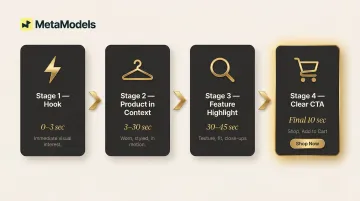
High-converting fashion shoppable videos follow a proven structural formula:
The conversion-focused structure:
- Hook (0-3 seconds): Immediate visual interest—product reveal, styling moment, or transformation
- Product in context (3-30 seconds): Show the product worn, styled, and in motion—not just displayed
- Feature highlight (30-45 seconds): Close-ups of texture, fit, versatility, or unique details
- Clear CTA (final 10 seconds): Direct instruction to shop, add to cart, or explore the collection
Keep total length under 60-90 seconds for social formats. 71% of viewers decide whether to keep watching within the first 3 seconds, so the opening must immediately establish visual interest and product context.
Production essentials for fashion:
- Proper lighting to show fabric color and texture accurately
- Vertical or square format optimized for mobile viewing
- Captions for sound-off viewing (majority of social video is watched muted)
- Close-up shots showing detail and texture that static images can't convey
- Natural movement that demonstrates how garments fit and flow
Step 5: Tag Products and Add Calls-to-Action
Product tagging connects viewer interest to purchase action, but poor execution kills conversions. Tags should appear within 1-2 seconds of the product being featured on screen, remain visible long enough to be tapped, and focus on the most relevant item per scene.
Tagging best practices:
- Link SKUs to clickable hotspots or overlay buttons positioned where viewers naturally look
- Display product names, variants, and pricing without overwhelming the visual experience
- Limit tags to 1-2 products per scene—avoid cluttering the frame with multiple clickable elements
- Time tags to appear during peak interest moments (after a styling reveal or product close-up)
CTA placement strategy:
- Place CTAs when viewer interest peaks—right after showing the product in action
- Use action-oriented language: "Shop This Look," "Add to Cart," "Get the Look"
- Make buttons large enough to tap easily on mobile screens (minimum 44x44 pixels)
- Test CTA placement in different positions to find what drives the highest click-through rate
Types of Fashion Shoppable Video Content That Convert
Not all video formats perform equally. Content type should match the product category and the buyer journey stage—discovery, consideration, or purchase-ready.
Styling Tutorials and How-To Videos
Tutorial-format videos show products in use across multiple outfit combinations, answer styling questions, and build aspiration, with individual items tagged as they appear on screen.
These videos reduce return rates by setting accurate expectations about fit, color, and versatility. Retailers who added product videos to their pages reduced return rates by 12-18% within six months, saving substantial costs while improving customer satisfaction.
Why styling tutorials convert:
- Demonstrate versatility by showing multiple ways to wear the same piece
- Answer common questions (How does it fit? What do I wear it with?)
- Provide styling inspiration that drives multi-item purchases
- Build trust by showing realistic on-body movement and fit
Lookbooks and Collection Showcases
Lookbook-style videos work well for seasonal launches and curated collections. Models wear coordinated outfits across styled settings, with each piece tagged for direct purchase, replicating the in-store browsing experience digitally.
For brands managing large SKU catalogs, producing lookbook content across hundreds of products traditionally required extensive physical shoots. AI model platforms enable consistent, diverse, on-model visuals at scale without repeated productions, cutting both turnaround time and production overhead.
Influencer and UGC Collaborations
Brand-produced content can only go so far. Influencer and user-generated content fills the gap, showing real people wearing clothes in relatable contexts and providing the social proof that consistently drives purchase decisions in fashion e-commerce.
UGC drives 3-5x higher on-site conversion rates than highly polished studio content. Authenticity consistently outperforms production value in fashion video.
How to make UGC shoppable:
- Repurpose creator content with embedded product tags
- Secure proper usage rights before publishing
- Choose creators whose audience demographics align with your target customer
- Feature diverse body types, styling approaches, and real-world contexts
Live Shopping Events
Live shopping creates real-time urgency through new arrivals, exclusive drops, or limited-time promotions. Viewers ask questions and purchase in the moment, driving conversion rates of 9-30%, which far exceeds standard e-commerce benchmarks.
The post-event opportunity is just as significant. Live videos can be saved and made permanently shoppable, and replays can account for up to 75% of a live event's total revenue. A single stream can keep generating returns for months.
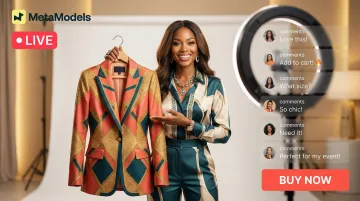
To maximize live shopping value:
- Save and publish the replay immediately after the event ends
- Ensure all product tags remain active in the archived version
- Clip highlight moments for short-form social distribution
- Pin the replay to your storefront or shoppable video gallery
Key Parameters That Affect Fashion Shoppable Video Results
Even well-produced shoppable videos underperform when core variables are miscalibrated. The difference between a video that converts and one that doesn't usually comes down to four controllable factors.
Visual Quality and Product Clarity
Fashion purchase decisions are heavily visual — viewers need to clearly see fabric, fit, color, and styling detail. Poor lighting or low resolution directly reduces viewer confidence and click-through rates.
Authenticity often outperforms polish here. 85% of marketers consider visual UGC more cost-effective than traditional professional photography, and UGC consistently drives higher conversion rates despite lower production budgets.
Quality requirements:
- Accurate color representation — lighting must show fabric truthfully
- Resolution high enough to reveal texture and detail (minimum 1080p, ideally 4K)
- Clear focus on product features that differentiate the item
- Authentic context that shows how the product looks in real environments
Product Tagging Placement and Timing
Tags that appear too early (before the product is shown) or too late (after viewer interest peaks) miss the conversion window. Overcrowded tags create visual noise and reduce clicks.
Optimal tagging strategy:
- Tags appear within 1-2 seconds of the product being featured on screen
- Remain visible long enough to be tapped (minimum 3-4 seconds)
- Focus on the most relevant item per scene — don't tag everything at once
- Position tags where viewers naturally look (near the product itself, not corners)
Content Length and Hook Strength
Attention drop-off in short-form fashion video is steep. If the hook doesn't establish visual interest and product context within the first 3 seconds, most viewers won't reach the point where CTAs appear.
Videos that hook viewers in the first 3 seconds boost engagement by 2x and increase purchase intent by 43%. Structure your content accordingly:
Recommended length by format:
- TikTok/Instagram Reels: 15-30 seconds (7-15 seconds achieves highest retention)
- Tutorial content on website embeds: 60-90 seconds
- Live shopping replays: Variable, but highlight clips should be under 2 minutes
Mobile Optimization
Mobile devices account for 81% of fashion e-commerce traffic and 56.4% of holiday online spend. Videos not formatted for vertical viewing, fast load times, and tap-friendly CTAs will underperform regardless of content quality.
Mobile optimization requirements:
- Vertical or square aspect ratio (9:16 or 1:1)
- Captions for muted viewing (most social video is watched with sound off)
- Fast load times — compress file size without sacrificing resolution
- Minimum tap target size of 44x44 pixels for product links and CTAs
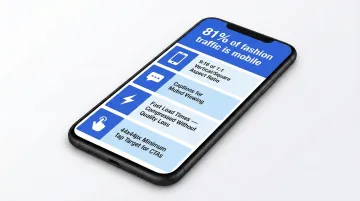
Vertical videos generate 130% higher engagement rates compared to horizontal videos on mobile platforms.
Common Mistakes When Creating Fashion Shoppable Videos
Most shoppable video failures come down to a handful of recurring errors. Avoid these before you hit publish:
- Weak visual foundation: Viewers lose confidence fast when product imagery doesn't clearly show fit, fabric, and styling — poor on-model visuals drive abandonment before any click happens.
- Over-tagging scenes: Too many clickable elements competing for attention dilutes focus. Limit tags to one or two key products per scene.
- Ignoring mobile behavior: Landscape formats, small CTA buttons, and missing caption overlays all hurt engagement for mobile-first shoppers.
- No tracking before launch: Going live without configuring click-through, add-to-cart, and conversion tracking makes it impossible to tell what's working. Set up analytics first, then publish.
Measuring the Success of Your Fashion Shoppable Video Campaigns
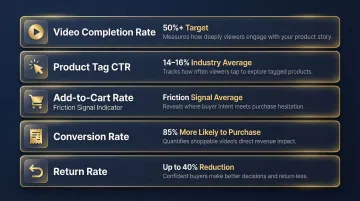
Start with engagement: view counts, average watch duration, and completion rate reveal whether content holds attention long enough for CTAs to land. A drop-off before the 50% mark points to a hook or pacing problem worth fixing before scaling spend.
From there, layer in purchase-intent signals — CTR on product tags, add-to-cart events, and which video moments generate the most clicks. Pair that with downstream data: how many video-initiated sessions end in completed purchases, and whether those buyers return less often or spend more than visitors from other channels.
Key metrics to track:
- Video completion rate: A strong indicator of hook quality — under 50% completion usually means the opening needs work
- Product tag CTR: Measures purchase intent (case studies report 14-16% CTR for well-executed shoppable videos)
- Add-to-cart rate: Reveals friction between interest and intent — low rates often signal tag placement or product presentation issues
- Conversion rate: The bottom-line measure — viewers who watch product videos are 85% more likely to purchase
- Return rate: Accurate video styling reduces returns by up to 40%, making this a useful proxy for content quality
Conclusion
Creating shoppable video content for fashion products works best when visual quality, product tagging, platform fit, and content format align with your target audience's buying behavior. Most underperformance stems from skipping the visual preparation stage or over-complicating the in-video shopping experience—simpler, well-produced content with clear CTAs consistently outperforms elaborate videos with poor setup.
The brands winning with shoppable video treat it as an iterative system, not a one-time launch. Pick one format, run it, and measure it before expanding:
- Test one content format per campaign cycle before adding more
- Review analytics for click-through and purchase data, not just view counts
- Refine based on what converts, then replicate those conditions at scale
The strongest foundation is always the visual itself — sharp, well-styled product imagery that holds up in motion is what makes every other element perform.
Frequently Asked Questions
What types of fashion products work best in shoppable videos?
Visually distinctive items—outfits, accessories, footwear—that benefit from being seen in motion or on a person perform best. Products where fit, drape, or styling context matters convert significantly better than basics or commodity items with low visual differentiation.
How long should a shoppable fashion video be for best results?
15-30 seconds for TikTok and Instagram Reels, up to 60-90 seconds for tutorial formats on brand websites. Keep it as short as needed to show the product convincingly and include a clear CTA — without losing viewer attention.
Which platforms are best suited for fashion shoppable video content?
Instagram and TikTok lead for discovery-driven fashion content, while embedding shoppable video widgets directly on brand websites or product pages delivers higher conversion rates from purchase-intent traffic. Match platform to buyer journey stage.
Do I need professional models and photoshoots for every shoppable fashion video?
High-quality on-model visuals matter in fashion video. AI model platforms like MetaModels.ai let brands generate diverse, human-verified on-model imagery directly from packshots, which cuts dependency on costly shoots per SKU without sacrificing visual quality or garment accuracy.
How do I tag products in a shoppable video?
Tagging methods vary by platform. TikTok and Instagram have native product-tagging tools integrated with their shopping features, while website-embedded shoppable videos require a dedicated video commerce platform or plugin that syncs with your product catalog and supports in-video hotspot creation.
What metrics matter most when measuring shoppable fashion video performance?
The three most important metrics are product tag click-through rate (purchase intent), add-to-cart rate (friction measure), and video completion rate (content quality signal). Also track conversion rate and return rate for a complete picture of campaign effectiveness.