Introduction
Digital transformation is one of the most heavily invested business priorities today — 90% of organizations are currently implementing some form of it. Yet despite widespread ambition and significant budgets, most initiatives underdeliver. Gartner's 2024 survey found that only 48% of digital initiatives meet or exceed business outcome targets. McKinsey puts the failure rate for large-scale transformations at 70%.
Without a clear model guiding where and how change happens, ambition alone rarely delivers results. Digital transformation exists in distinct models, each targeting a different part of the business. Choosing the wrong one leads to wasted investment, slow adoption, or change that doesn't stick.
This article explains the key types of digital transformation models, what makes each one different, and how to identify the right fit for your organization.
Key Takeaways
- Digital transformation integrates technology across business areas to improve operations and deliver better customer outcomes
- Six key models exist: Process, Business Model, Customer-Centric, Data-Driven, Cultural/Organisational, and Domain
- No model is universally best—the right choice depends on goals, readiness, and where the most critical gap exists
- Most successful transformations layer multiple models over time, but the right starting point accelerates momentum
- Choosing based on trends—not honest internal assessment—is the most common reason transformations fail
What Is a Digital Transformation Model?
A digital transformation model is a structured framework that determines how a business will integrate digital technology. It defines the scope, focus area, and approach of the transformation—not just the tools used.
The distinction matters: "Digital transformation" broadly refers to integrating technology to improve business performance. A "digital transformation model" is the specific strategic lens through which that transformation is directed and executed. It tells you where digital investment goes, what success looks like, and which parts of the organization need to change.
Without that clarity, transformation becomes a series of disconnected technology purchases rather than coherent strategic change.
Why Digital Transformation Models Matter
Choosing between transformation approaches is only half the challenge. Without a defined model to guide execution, organisations invest in technology without a unifying direction — leading to wasted spend, internal resistance, and no clear way to track results. Analysis of 1,700 global programmes found only about one-third succeed at scale, with cultural readiness accounting for over half the variance in value capture.
The value of choosing the right model is that it:
- Focuses limited resources on the business area with highest potential return
- Reduces scope creep and wasted effort
- Gives leaders a shared language for prioritising change
- Creates measurable milestones aligned to specific outcomes
In practice, the right model turns transformation from an open-ended technology initiative into a structured programme with clear priorities, defined outcomes, and a shared roadmap for everyone involved.
Key Types of Digital Transformation Models
Digital transformation is not one-size-fits-all. The model a business adopts should reflect where its biggest gap or opportunity lies—whether that's internal efficiency, revenue strategy, customer relationships, data use, culture, or market expansion.
Process Transformation
What it is and how it works:
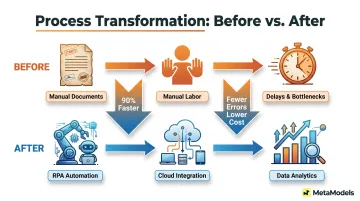
Process transformation focuses on redesigning internal workflows and operations using digital tools such as automation, AI, robotic process automation (RPA), cloud computing, and analytics. The goal is to eliminate manual steps, reduce errors, and accelerate how work gets done across functions.
McKinsey reports the warehouse automation market is growing by more than 10% per year, with robot shipments expected to increase by up to 50% annually through 2030.
In e-commerce and fashion, brands are applying this model by replacing time-intensive content production workflows with AI-powered imagery platforms that generate ready-to-use product visuals at scale. MetaModels.ai, for example, converts packshots to on-model imagery without physical models or studio shoots.
Best suited for:
- Organisations where operational inefficiency, high processing costs, or slow delivery cycles are the primary pain point
- Manufacturing, logistics, healthcare, retail, and e-commerce where process bottlenecks directly impact profitability or customer experience
- Businesses seeking measurable ROI quickly—process transformation typically delivers visible results faster than strategic models
Limitations:
Process transformation alone does not change the business model or organisational culture. Efficiency gains can plateau if upstream strategic or structural issues remain unaddressed. It also requires careful change management to ensure employees adopt new workflows rather than reverting to old habits.
Business Model Transformation
What it is and how it works:
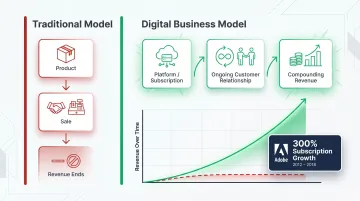
Business model transformation involves fundamentally rethinking how a company creates, delivers, and captures value. Organisations shift from traditional product or service delivery toward digitally enabled revenue models: subscriptions, platforms, digital marketplaces, or outcome-based pricing.
This model changes not just how work is done, but how the business makes money.
McKinsey found subscription businesses grew more than 300% from 2012 to 2018—approximately five times faster than S&P 500 revenues. Adobe's shift to subscriptions moved $2 billion in Creative Suite revenue to recurring subscriptions in approximately three years, then grew that base by 20% annually for the following three years.
Best suited for:
- Companies facing market disruption, declining relevance, or competitive pressure from digital-first entrants
- Businesses transitioning from physical to digital delivery channels or from one-time transactions to recurring revenue relationships
- Organisations with strong existing customer bases that could deliver more value through new monetisation models
Limitations:
This is the most strategically disruptive and highest-risk transformation type. It requires C-suite alignment, significant investment, and willingness to accept short-term revenue uncertainty while the new model gains traction. It's also the hardest to reverse if the new model fails to achieve market fit.
Customer-Centric Transformation
What it is and how it works:
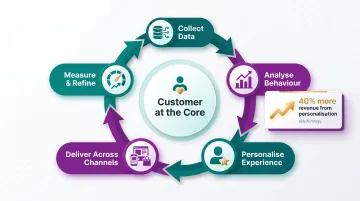
Customer-centric transformation places the customer experience at the centre of digital strategy. It uses data, AI, personalisation engines, and omnichannel tools to create seamless, relevant, and consistent interactions across every customer touchpoint. Decisions about products, content, service, and communications are driven by real-time customer behaviour and preference data.
McKinsey's research shows fast-growing companies drive 40% more revenue from personalisation than slower-growing counterparts. Additionally, 71% of consumers expect personalised interactions and 76% get frustrated when they don't receive them.
Best suited for:
- Consumer-facing businesses where customer retention, lifetime value, and brand loyalty are primary competitive differentiators
- Retail, e-commerce, financial services, and hospitality
- Markets where differentiation on product alone is increasingly difficult
Limitations:
This model requires robust data infrastructure, ongoing investment in analytics capabilities, and strong data governance. Personalisation efforts can backfire if data privacy or consent management is mishandled—cumulative GDPR fines now exceed €7.1 billion since 2018. Measurable impact on revenue can take time to emerge, making short-term ROI justification challenging.
Data-Driven Transformation
What it is and how it works:
Data-driven transformation centres organisational decision-making on data by building analytics infrastructure, data pipelines, and AI or machine learning capabilities that convert raw data into actionable business intelligence. It replaces intuition-based decisions with evidence-based strategy across operations, marketing, product, and customer service.
Organisations that track over 80% of transformation KPIs are 22 percentage points more likely to realise value, highlighting the measurable advantage of data-centric approaches.
Best suited for:
- Organisations with large datasets that are currently underutilised
- Financial services, retail, supply chain, and healthcare where prediction, pattern recognition, and real-time insight create measurable competitive advantage
- Businesses looking to reduce risk while scaling
Limitations:
This model requires significant upfront investment in data infrastructure, engineering talent, and governance frameworks. Poor data quality or inconsistent data practices can undermine the initiative. Results depend on organisational willingness and culture to act on data insights rather than defaulting to established norms.
Cultural and Organisational Transformation
What it is and how it works:
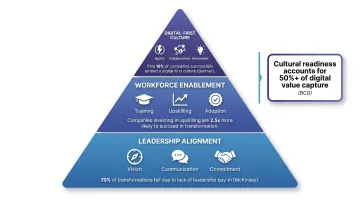
Cultural transformation focuses on the human side of change: shifting mindsets, behaviours, leadership structures, and skills to build a workforce that embraces digital-first ways of working. It often runs alongside or precedes other transformation types as an enabling layer.
BCG's analysis found cultural readiness accounts for over half the variance in digital value capture. Deloitte reports that tech-focused organisations are 1.6 times more likely to NOT realise returns on AI investments compared to those taking a human-centric approach.
Best suited for:
- Organisations where internal resistance to change, siloed departments, or legacy leadership behaviours are the primary obstacle to transformation success
- Businesses where previous technology rollouts have failed due to low adoption rather than poor technology choices
- Companies preparing for larger transformation programmes that will require workforce buy-in
Limitations:
Cultural transformation is the hardest type to measure and the slowest to produce visible results. Without sustained, visible commitment from senior leadership, cultural shifts often regress. This model cannot be delegated to HR alone—it requires behavioural change at the top before it takes hold at the front line.
McKinsey recommends matching every unit of investment in digital solutions with equal spend on change management.
Domain Transformation
What it is and how it works:
Domain transformation uses existing digital capabilities to move into adjacent markets, create new product categories, or enter entirely new industries. Organisations apply their technology, data, or platform strengths to expand beyond their core business, enabled by cloud, IoT, or AI.
Amazon Web Services (AWS) is the clearest example—Amazon leveraged internal infrastructure capabilities built for e-commerce to create an external cloud computing platform. AWS segment sales reached $128.7 billion in 2025, up 20% year-over-year.
Best suited for:
- Established companies that have already built strong digital capabilities in their core business
- Tech-forward organisations with platform-level assets (data, infrastructure, customer relationships) that could generate value in adjacent markets
- Businesses seeking new growth vectors after optimising core operations
Limitations:
Domain transformation requires deep knowledge of the new domain's competitive dynamics, customer expectations, and regulatory context. Entering new markets without this often leads to overextension. It demands new talent profiles, partner relationships, and operational capabilities that may not currently exist within the organisation.
How to Choose the Right Digital Transformation Model
The right model is determined by where the most critical gap or highest-value opportunity exists in the business—not by what's trending or what competitors are doing.
Key assessment factors include:
- Primary business goal: Efficiency, growth, customer experience, or new revenue
- Organisational readiness: Leadership alignment, talent, culture
- Available budget and risk tolerance: Capital, capacity to absorb short-term disruption
- Current technology maturity: Infrastructure, data quality, digital capabilities
Most successful transformations eventually layer multiple models. Starting with the one that addresses the most urgent business challenge generates early wins, builds internal confidence, and sustains momentum for broader change.
| Priority | Recommended Starting Point |
|---|---|
| Speed and measurable ROI | Process transformation — fastest path to visible results |
| Long-term strategic repositioning | Business model or domain transformation — but only after foundational capabilities are in place |
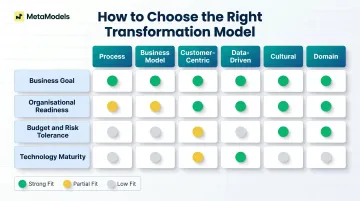
For organisations unsure where to begin, a structured internal audit—mapping current pain points to the six model types—is more reliable than benchmarking against industry peers whose context, resources, and starting points may be different.
Common Mistakes to Avoid When Selecting a Model
Choosing the Most Advanced Model Over the Right One
Investing in domain transformation or business model redesign before fixing broken internal processes or data infrastructure will undermine any new initiative. McKinsey's research shows 80% of successful interventions in struggling transformations involve re-anchoring scope to a well-defined domain rather than attempting enterprise-wide change.
Underestimating the Cultural Dimension
Technology is rarely the reason transformations fail. Nearly two-thirds of employees resist organisational change, and all four identified pitfalls of transformation failure — low aspirations, lack of purpose, poor execution, failure to sustain — are leadership and behaviour issues. Selecting a model without a parallel change management plan is one of the most consistent reasons digital investments don't deliver expected returns.
Selecting Based on Familiarity Rather Than Current Needs
Cultural readiness aside, even the strategic framing of model selection is frequently mishandled. What worked for a large enterprise may be entirely wrong for a mid-market business at a different stage of digital maturity. An honest audit of current pain points, capabilities, and strategic priorities must drive model selection — not what worked at a previous organisation or what peers are currently chasing.
Conclusion
Digital transformation is not a single initiative — it's a direction set by the model a business chooses. Each of the six types serves a distinct purpose:
- Process Transformation — eliminating inefficiency at the operational level
- Business Model Transformation — rethinking how value is created and delivered
- Customer-Centric Transformation — rebuilding around the customer journey
- Data-Driven Transformation — making decisions from insight, not instinct
- Cultural/Organisational Transformation — shifting how people work and lead
- Domain Transformation — expanding into new markets or capabilities
Understanding these distinctions gives leaders a practical framework for directing investment and managing change with intention.
Honest self-assessment is the deciding factor: the right model addresses your most pressing business challenge, matches your team's current capabilities and change appetite, and gives everyone a concrete starting point — not just a buzzword.
Frequently Asked Questions
What are the models of digital transformation?
The six main models are Process Transformation (operational efficiency), Business Model Transformation (revenue strategy), Customer-Centric Transformation (experience optimisation), Data-Driven Transformation (analytics-based decision-making), Cultural/Organisational Transformation (people and mindset), and Domain Transformation (market expansion). These are not mutually exclusive—organisations often combine models based on their needs.
What is the difference between process transformation and operational transformation?
These terms are frequently used interchangeably. Process transformation typically refers to redesigning specific workflows with digital tools such as automation and RPA. Operational transformation is broader and addresses how entire operational functions deliver value—both focus on internal efficiency, but operational transformation encompasses wider functional redesign.
Can a business use more than one digital transformation model at the same time?
Yes—most mature transformation programmes layer multiple models. The key is sequencing them strategically, beginning with the model that addresses the most urgent need before expanding scope. This builds momentum and keeps the programme manageable.
How long does a digital transformation typically take?
Timelines vary significantly by model type. Process-level changes can show measurable results within months, while business model or cultural transformation typically unfolds over several years. Domain transformation generally generates value within 6 to 36 months, depending on scope and complexity.
What are the most common reasons digital transformation initiatives fail?
Leading causes include lack of clear model or strategic direction, insufficient change management, leadership misalignment, and underestimating the cultural and people dimensions of transformation. Technology failure is rarely the root cause. In most cases, people-related factors are what derail initiatives.
How do I know which digital transformation model is right for my organisation?
Start with an honest internal assessment of your most critical gap — operational efficiency, revenue model relevance, customer experience, or data maturity. Choose the model that most directly addresses it, and confirm leadership alignment and cultural readiness before committing resources.