Introduction
Gensmo made headlines in mid-2025 when it secured $60M+ in angel funding and rapidly scaled to 1M+ downloads as a consumer AI styling app, offering virtual try-on features and personalized outfit recommendations to individual shoppers. The problem for brands: Gensmo targets consumers looking to visualize clothes on themselves before buying—not the B2B workflow that fashion brands and e-commerce teams actually need—converting garment packshots into professional, catalog-ready model imagery at scale.
AI fashion model generation solves a different problem entirely. Brands upload flat-lay or ghost mannequin product photos and receive photorealistic images of those garments on AI-generated models—no studio booking required. The cost case is straightforward:
- Traditional shoots run $15,000–$50,000 per session
- Model fees add $500–$2,500 per half-day, plus 20–50% for post-production
- Mid-size brands managing 500 SKUs spend $125,000–$250,000 annually just to maintain visual content
This guide covers the best purpose-built alternatives for brands that need production-ready, on-model imagery without the studio bookings—platforms optimized for e-commerce output quality, model diversity, and scalability across thousands of SKUs.
Key Takeaways
- Gensmo is a consumer try-on app, not a B2B catalog production tool—brands need dedicated platforms that convert packshots to publish-ready model imagery
- Leading AI fashion model generators eliminate model fees, studio costs, and post-production delays while covering entire product catalogs at scale
- Evaluate platforms on resolution (up to 4K), fabric draping accuracy, model diversity, pricing transparency, and human QC options
- MetaModels.ai, Botika, Fashn.ai, and Revery.ai are the strongest B2B contenders in 2026—each suited to different production needs
- Choose based on production volume, garment complexity, and whether custom brand models or multi-garment outfit generation matters most
What Is AI Fashion Model Generation and Why Brands Are Switching
AI fashion model generation is a B2B production workflow where brands upload flat-lay or packshot images of garments, and specialized AI platforms render those items onto photorealistic virtual models—creating catalog-ready product imagery without booking real models, renting studios, or coordinating photoshoots. This is fundamentally different from consumer virtual try-on apps (like Gensmo) that let individual shoppers preview how clothes might look on their own bodies before purchasing.
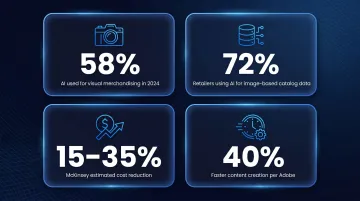
The numbers explain why brands are moving fast. The global AI image generator market reached $349.6 million in 2023 and is projected to hit $1.08 billion by 2030, growing at 17.7% annually. Fashion-specific adoption is keeping pace:
- 58% of fashion companies used AI for visual merchandising in 2024
- 72% of fashion and beauty retailers rely on AI to manage image-based catalog data
- McKinsey estimates AI adoption delivers 15–35% cost reductions in merchandising and distribution
- Adobe reports 40% faster content creation for marketing teams
By 2025–2026, the best platforms deliver production-grade output at 2K–4K resolution, curated libraries of diverse AI models spanning multiple ethnicities and body types, and human review layers that verify garment accuracy before delivery—at costs and turnaround times traditional photography can't match.
Best Gensmo Alternatives for AI Fashion Model Generation in 2026
Each platform below was evaluated on output quality, garment rendering accuracy, model library diversity, pricing transparency, and scalability for e-commerce catalog production.
MetaModels.ai
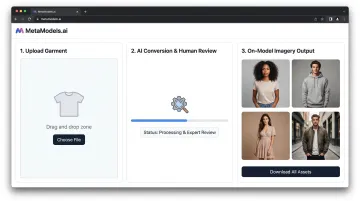
MetaModels.ai is an AI-powered fashion imagery platform built for fashion brands, e-commerce companies, designers, and marketing professionals who need catalog-ready model content at scale. It converts packshot images (flat-lay or ghost mannequin) into polished, human-reviewed model visuals — no physical models or studio time required.
What separates MetaModels.ai is its mandatory human-review layer: fashion specialists verify garment accuracy — color, shape, texture, print, and proportions — before delivery. Real-time fabric draping renders texture and fit accurately, and a curated model library spans diverse ethnicities, body types, and demographics. All content is delivered ready-to-post at up to 4K resolution with royalty-free licensing and no usage limits.
Key Features
- Packshot-to-model conversion with real-time fabric draping
- Human-reviewed outputs verified by fashion specialists
- Diverse model library across ethnicities, body types, and demographics
- Custom brand model creation
- Video generation
- Ready-to-post 4K resolution with royalty-free licensing
Output Quality Up to 4K resolution; human-verified for garment accuracy and brand consistency across all pricing tiers
Best For Fashion brands, e-commerce teams, and designers needing scalable, royalty-free model imagery without photoshoot costs or ongoing royalties
Botika
Botika is an AI fashion photography platform designed for apparel e-commerce brands that want to replace traditional model photoshoots with automated on-model imagery. It transforms flat-lay and mannequin product photos into professional on-model images, targeting online retailers looking to improve conversion through diverse model representation.
Botika's automated workflow swaps product images onto AI models at scale, with broad model diversity across skin tones and body types — practical for large SKU catalogs needing consistent output across thousands of listings. Processing time runs approximately 15 minutes per image, with human retouching available on Pro and Advanced tiers.
Results from existing customers are notable: Jordache cut production costs by 90%, and Nil+Mon achieved 95% cost reduction alongside 3-4x higher conversion rates.
Key Features
- AI model swapping from flat-lay and mannequin product photos
- Diverse model options across skin tones and body types
- Batch processing for large catalogs
- Shopify integration
- Human retouching services (Pro and Advanced tiers)
Output Quality HD (Lite tier), 2K (Pro tier), 4K (Advanced tier); processing time ~15 minutes per image
Best For Online retailers with high-volume SKU catalogs requiring fast, diverse on-model imagery at scale; brands prioritizing conversion optimization
Fashn.ai
Fashn.ai is a virtual try-on and AI model generation platform built for fashion brands and marketplaces. Teams use it to place garments onto AI-generated or custom-reference models for product pages, lookbooks, and social content — with processing speeds fast enough for production workflows.
Garment-adherence technology preserves fabric detail, pattern alignment, and fit realism during rendering. Fashn.ai is also API-first: full RESTful API access is available at every pricing tier, letting brands and marketplace operators integrate model generation directly into product listing workflows. All plans support up to 4K resolution, with virtual try-on processing in 5-17 seconds and product-to-model conversion in approximately 12 seconds.
Key Features
- Virtual try-on with garment-adherence rendering
- API integration across all pricing tiers
- Model reference customization
- Image-to-video generation
- Fast processing (5-17 seconds for try-on)
Output Quality Up to 4K resolution for images (all tiers); 720p (Basic) or 1080p (Pro+) for video; processing in 5-17 seconds
Best For Fashion marketplaces, DTC brands, and developers integrating AI model generation into e-commerce pipelines via API
Revery.ai
Revery.ai is an AI outfit visualization and model generation platform focused on helping fashion brands create on-model imagery and complete look generation. Unlike single-garment tools, it renders full outfit combinations on AI models — covering lookbook production and editorial content alongside standard product page photography.
Mix-and-match outfit generation supports brands that need cohesive editorial and campaign imagery, not just individual PDPs. Revery handles over 1 million SKUs per week, and its virtual dressing room feature is linked to 20-25% conversion rate increases. Pricing starts free (up to 100 try-on images with watermark), with paid plans from $50/month for 4,000 try-on images and up to 500 garments.
Key Features
- Full outfit generation on AI models with mix-and-match capabilities
- Multi-garment combination rendering
- Lookbook and editorial content support
- Virtual dressing room experience
Output Quality Specific resolution details not publicly disclosed; capable of processing 1M+ SKUs weekly with high-volume optimization
Best For Fashion brands producing seasonal lookbooks, editorial campaigns, and multi-garment outfit visuals using AI models
How We Chose the Best AI Fashion Model Generation Platforms
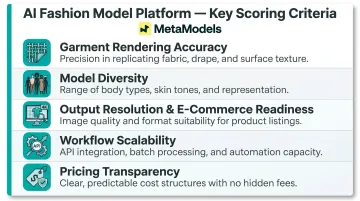
Each platform was scored on five criteria:
- Garment rendering accuracy — how well the AI preserves texture, pattern, and fit when placing garments on models
- Model diversity — body type, ethnicity, and demographic range to support inclusive brand representation
- Output resolution and e-commerce readiness — measured against marketplace standards (Amazon requires minimum 1000×1000px; Shopify recommends up to 4472×4472px)
- Workflow scalability — batch processing and API support for high-SKU catalogs
- Pricing transparency — clear credit systems and verifiable usage rights
These criteria exist because demo output rarely tells the full story. Brands commonly choose tools based on showcase images alone, then find performance drops sharply on their actual garment categories. Sheer fabrics, knitwear, and structured outerwear each require different AI rendering approaches. Platforms with dedicated fabric-specific models produce far more consistent results across diverse product lines.
Human oversight and quality control options carried significant weight in our scoring — the real cost of any tool includes QC time and revision cycles, not just subscription fees. Professional product photos drive 40% higher conversion rates, and 93% of shoppers say visuals are the deciding factor when purchasing. Given those stakes, output accuracy isn't optional. On licensing: every platform reviewed includes royalty-free rights in its subscription, but brands pursuing white-label or resale use cases should verify terms directly before committing.
Conclusion
While Gensmo and similar consumer AI styling apps serve individual shoppers, fashion brands and e-commerce operators need purpose-built AI model generation platforms that deliver production-grade imagery, garment accuracy, and scalable workflows. The tools listed above represent the strongest options in 2026, each targeting a distinct use case:
- MetaModels.ai — human-reviewed accuracy with unlimited commercial rights
- Botika — high-volume catalog automation at scale
- Fashn.ai — API-driven integrations for developer workflows
- Revery.ai — multi-garment editorial and lookbook content
Evaluate tools against your catalog complexity, output volume, and brand identity requirements before committing. Feature lists only go so far — run trials on your actual packshots, focusing on categories that stress-test the system:
- Sheer fabrics and lightweight materials
- Heavy knitwear and textured weaves
- Structured outerwear with complex construction
Review outputs against your quality standards and confirm that model diversity reflects your brand's representation goals.
For teams prioritizing human-reviewed accuracy, model diversity, and packshot-to-model conversion with no royalties or usage limits, MetaModels.ai covers the full production pipeline — from raw packshot to publish-ready 4K imagery — with a fashion specialist reviewing every image before it reaches your team.
Frequently Asked Questions
What is the difference between AI fashion model generation and virtual try-on?
AI fashion model generation creates new product imagery by placing garments on AI models from packshots—a B2B production tool for brands to build catalogs without photoshoots. Virtual try-on lets consumers preview how items would look on themselves before purchasing. These serve different audiences: one replaces studio photography workflows for brands, the other enhances shopping experiences for individual customers.
Can AI-generated fashion model images fully replace traditional photoshoots?
AI model generation can replace most standard catalog and product detail page imagery cost-effectively, especially for straightforward garment categories. Complex editorial shoots, texture-heavy fabrics, or brand campaigns requiring a distinct creative direction may still benefit from human photographers and stylists.
How do AI fashion model generation tools handle fabric texture and draping accuracy?
Leading platforms use fabric simulation models trained on large fashion datasets to render drape, texture, and fit. Results vary by garment type—structured tailoring renders more reliably than sheer or heavily textured fabrics. Platforms like MetaModels.ai add a human review layer to catch accuracy issues before delivery.
Are AI-generated model images legally cleared for commercial use?
Most B2B platforms include commercial usage rights and royalty-free licensing in their subscriptions. Always confirm terms for white-label or resale use cases—Botika, Fashn.ai, and MetaModels.ai include commercial rights in paid tiers, but resale restrictions vary by provider.
What image resolution do AI fashion model generation tools typically output?
Output resolution ranges from HD (1080p) on entry-level plans to 4K on premium tiers. Fashn.ai and MetaModels.ai offer 4K across all subscription levels, while Botika scales resolution by plan (HD/2K/4K).
How long does it take to generate AI model images from packshots?
Most platforms generate results in seconds to a few minutes per image in automated mode—Fashn.ai processes virtual try-on in 5-17 seconds, while Botika takes approximately 15 minutes per image. Platforms offering human review add a QC layer that extends turnaround to hours or a business day depending on volume and service tier, but this ensures garment accuracy before delivery.